
Building Scanning Services Nyc
Table of Contents
Discovering Building Scanning Services in New York City
Navigating the dense urban landscape of New York City presents unique challenges for architecture, engineering, and construction professionals, from high-rise developments to historic renovations. Building scanning services in New York City emerge as vital solutions, employing advanced 3D laser scanning and LiDAR technologies to capture precise as-built conditions with millimeter accuracy. These tools create digital twins of structures, enabling seamless integration into BIM modeling for clash detection and facility management.
At BuildScan3D, we lead as a premier provider of 3D laser scanning in New York City, utilizing certified Leica, Faro, and Navvis equipment to serve projects across Manhattan, Brooklyn, and the tri-state area, including New Jersey and Long Island. Our LiDAR scanning services in New York City address urban 3D surveying solutions by tackling dense site constraints and ensuring compliance with local building codes. For instance, we document iconic bridges and towering skyscrapers, reducing rework through accurate point cloud data that supports coordination in AEC workflows, as outlined in comprehensive guides on 3D laser scanning applications.
Initial project scoping begins with site assessments and consultations to tailor precise building documentation in NYC to your needs. Explore our expertise in 3d laser scanning manhattan and beyond, as we delve deeper into technology fundamentals, benefits, processes, and best practices in the following sections. Contact us today to discuss your next urban project.
Understanding 3D Laser Scanning for Buildings
In the bustling construction landscape of New York City, accurate documentation of existing structures is essential for renovations and new builds. Technologies like 3D laser scanning and LiDAR enable professionals to capture detailed as-built conditions efficiently. BuildScan3D specializes in these 3d scanning bronx services, supporting architects, engineers, and facility managers across the five boroughs.
Core Principles of 3D Laser Scanning Technology
3D laser scanning represents a cornerstone of digital building capture techniques, transforming physical spaces into precise digital replicas. This process begins with terrestrial or stationary scanners emitting laser beams that bounce off surfaces, capturing millions of data points per second to create a point cloud–a dense collection of 3D coordinates representing the scanned environment. For instance, in multi-story office buildings in Manhattan, these scanners methodically document interiors from multiple positions, ensuring comprehensive coverage despite tight spaces.
Mobile scanners complement this by allowing on-the-go data collection for larger exteriors. Building scanning services in New York City leverage these principles to generate BIM-ready models from point clouds, streamlining workflows in architecture, engineering, and construction. As a digital measuring tape on steroids, this technology achieves high-precision urban surveying in NYC, reducing errors in planning renovations or expansions. According to the complete guide on 3D laser scanning, the process involves data registration to align scans into a unified model, vital for projects requiring exact spatial data.
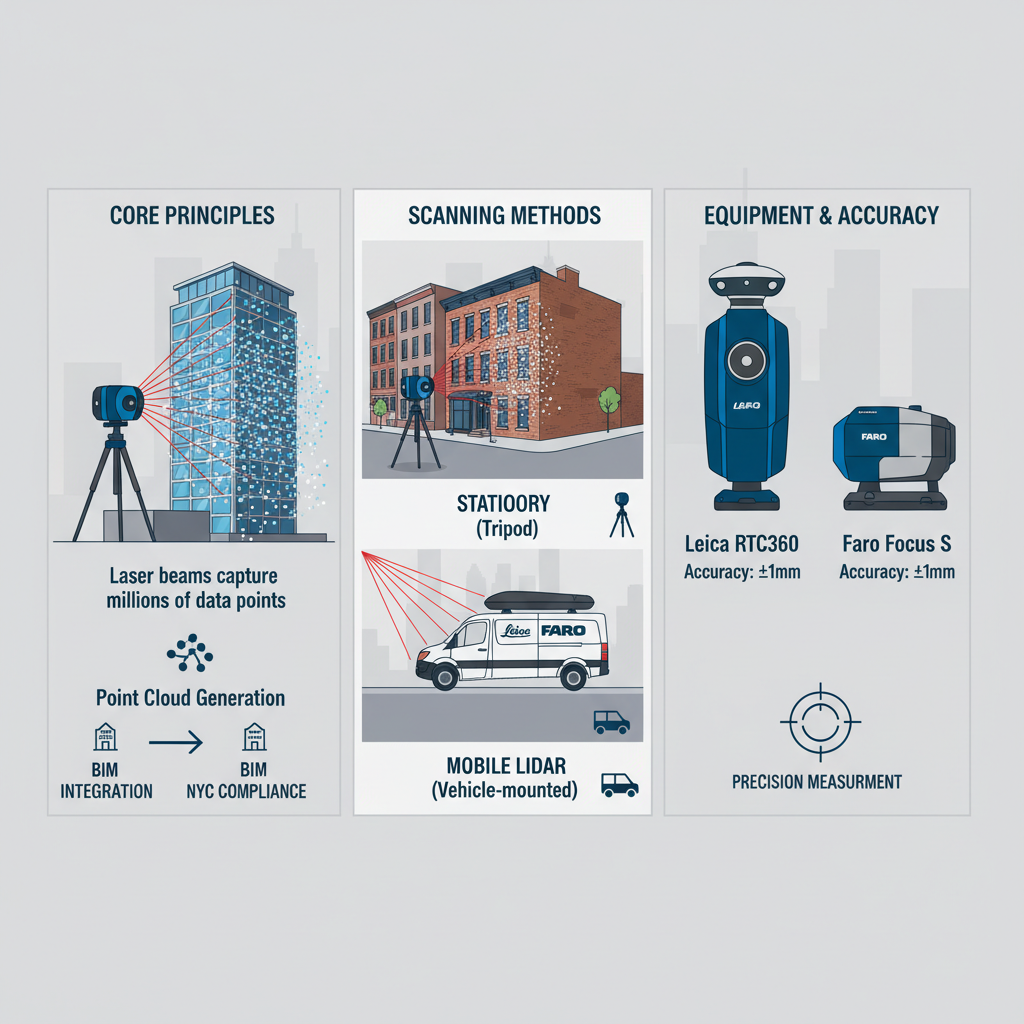
Fundamentals of 3D laser scanning and LiDAR for urban buildings in NYC
This foundational approach addresses common queries about what 3D laser scanning entails for buildings, emphasizing its role in capturing intricate details that traditional methods often miss.
LiDAR Scanning in Urban New York Environments
LiDAR, or Light Detection and Ranging, extends 3D laser scanning principles by integrating laser pulses with GPS and inertial measurement units for dynamic data acquisition. In dense urban settings like New York City, LiDAR scanning services in New York City prove invaluable for building documentation, particularly in infrastructure assessments. Stationary LiDAR excels in controlled interiors, such as scanning historic facades in Queens for preservation, while mobile variants mounted on vehicles navigate Brooklyn’s streets to map exteriors quickly.
Compared to traditional surveying, which relies on manual measurements prone to human error in crowded sites, LiDAR offers faster, more reliable results. For Bronx infrastructure projects, mobile LiDAR captures elevations and utilities without disrupting traffic, a key advantage in high-density areas. The NYC services reference highlights how these tools handle challenges like reflective glass on skyscrapers, ensuring point clouds remain accurate. This differentiation underscores LiDAR’s efficiency for time-sensitive urban projects, answering questions on its applications versus conventional techniques.
Transitioning from capture to application, understanding these methods empowers teams to select the right approach for Manhattan’s constrained access or tri-state expansions.
Key Equipment and Accuracy Standards in NYC
Leading providers like BuildScan3D employ certified scanners such as Leica BLK360 for stationary interior work and Faro Focus for detailed point cloud generation, alongside NavVis VLX for mobile exteriors. These tools deliver ±1mm accuracy, as validated in technical guides, producing deliverables like Revit files and 2D plans compliant with New York building codes. In facility management, this precision supports clash detection and HVAC modeling without field revisions.
NYC’s rigorous standards demand such high fidelity, especially for as-built documentation in renovations. Equipment calibration ensures models align with local regulations, facilitating coordination among contractors. BuildScan3D’s regional expertise, including certifications in laser scanning, positions it as a trusted partner for 3D laser scanning in New York City. By outlining these elements, professionals gain insight into selecting equipment that meets project tolerances, from aqueducts to office towers.
Overall, grasping these standards highlights how advanced gear transforms raw data into actionable insights, paving the way for enhanced project outcomes across the tri-state area.
Benefits of Building Scanning in New York City
Building scanning services in New York City have revolutionized how architecture, engineering, and construction (AEC) professionals tackle the challenges of dense urban environments. By leveraging advanced 3D laser scanning in New York City and LiDAR technologies, firms like BuildScan3D deliver precise data that enhances project efficiency and minimizes disruptions in bustling boroughs. These local digital surveying advantages address the unique demands of infrastructure, commercial renovations, and high-rise developments, providing code-compliant deliverables that streamline workflows from design to maintenance.
Enhanced Accuracy and Reduced Rework in Urban Projects
In the fast-paced world of New York City construction, precision is paramount, especially for complex Manhattan high-rises where even minor measurement errors can lead to costly delays. 3D laser scanning in New York City captures as-built conditions with millimeter accuracy, creating detailed point clouds that serve as reliable references for renovations and expansions. This technology minimizes field revisions by up to 30%, as highlighted in industry reports on urban project delivery, allowing teams to identify discrepancies early and avoid rework that plagues traditional surveying methods.
For instance, scanning efforts on iconic NYC landmarks like historic bridges have demonstrated how accurate data reduces on-site adjustments, saving weeks of labor in time-sensitive environments. BuildScan3D’s use of Leica and Faro scanners ensures that deliverables meet stringent local building codes, empowering contractors to proceed with confidence. By integrating these scans into project planning, AEC professionals in areas like Midtown experience enhanced accuracy that not only cuts errors but also boosts overall site safety in crowded urban settings. This approach transforms potential setbacks into seamless progress, underscoring the value of NYC project efficiency tools for high-stakes developments.
Streamlined BIM Modeling and Clash Detection Locally
Building Information Modeling (BIM) integration stands out as a core benefit of LiDAR scanning services in New York City, particularly for coordinating multidisciplinary teams in space-constrained sites. Scans provide rich datasets that fuel Revit models, enabling automated clash detection to spot interferences between structural, mechanical, and electrical systems before construction begins. In Brooklyn’s evolving commercial districts, this process has streamlined workflows, reducing coordination issues that often arise in dense borough layouts.
BuildScan3D excels in delivering BIM-ready files tailored for AEC teams across New York and the tri-state region, including seamless support for 3d scanning new jersey projects that extend city boundaries. Drawing from scan-to-BIM best practices, these models facilitate virtual walkthroughs for stakeholder reviews, cutting down on physical mockups and accelerating approvals. For renovations in mixed-use buildings, LiDAR data enhances HVAC modeling and spatial planning, ensuring compliance with NYC’s rigorous energy standards. This localized approach not only optimizes design phases but also fosters collaboration, answering key queries on BIM benefits for urban efficiency and positioning scanning as indispensable for modern project delivery.
Cost and Time Savings for NYC Facility Management
Adopting building scanning in the Bronx, Queens, and surrounding tri-state areas yields significant ROI through efficient facility management, transforming raw scan data into actionable insights for long-term operations. Case studies from NYC properties reveal time savings of 25-40% in asset inventories, where point clouds enable quick identification of equipment locations without invasive inspections. This proactive method supports maintenance planning, BOMA area calculations, and floor flatness analysis, directly tying into the 2025 cost guide estimates that project scanning payback periods as short as six months for urban facilities.
Key benefits include:
- Reduced Downtime: Virtual models allow remote assessments, minimizing disruptions in operational buildings like Queens warehouses.
- Budget Optimization: Early clash resolution prevents overruns, with documented savings of 15-20% on total project costs.
- Scalable Asset Tracking: Integrated deliverables for facility software enhance lifecycle management, from initial scans to ongoing monitoring.
Subtle testimonials from local managers highlight how BuildScan3D’s services have cut renovation timelines by 20% in the Bronx, providing quantifiable proof of value. These savings empower property owners to make informed decisions, aligning scanning investments with broader goals of sustainability and operational resilience in New York City’s dynamic real estate landscape.
How 3D Building Scanning Works in New York City
Building scanning services in New York City transform complex urban structures into precise digital twins, enabling architects, engineers, and contractors to navigate the challenges of dense boroughs like Manhattan and Brooklyn. This step-by-step NYC surveying process, tailored for the city’s fast-paced environment, involves advanced tools and methodologies to capture accurate as-built data. BuildScan3D’s workflow ensures seamless integration for AEC projects, from initial consultations to final deliverables, while addressing local factors such as traffic delays and permit requirements.
The urban scan-to-model pipeline begins with thorough site assessment, progresses through data capture, and culminates in actionable BIM outputs. This approach not only minimizes on-site disruptions but also supports compliance with New York City’s stringent building codes. For B2B clients, understanding this process facilitates better project scheduling and cost estimation, typically spanning 2-4 weeks for comprehensive scans.
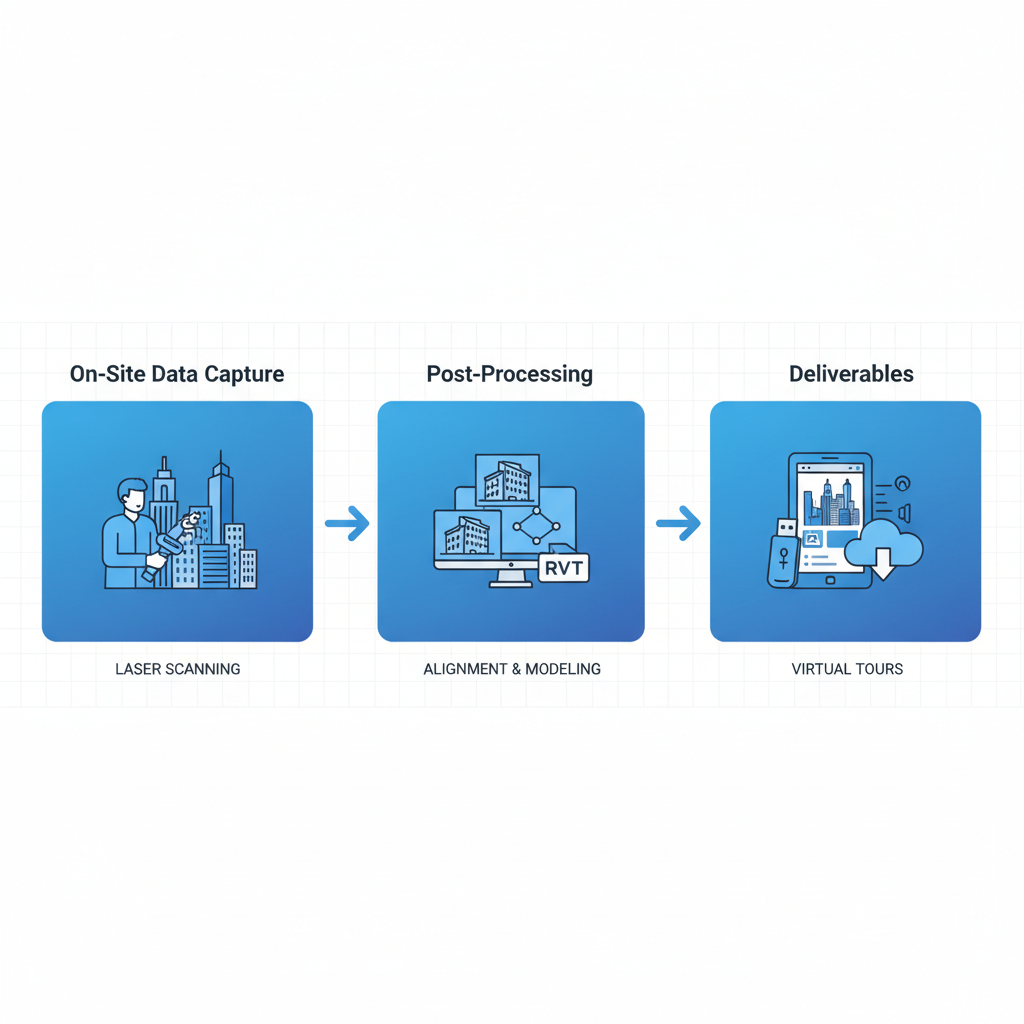
3D building scanning process in New York City: capture, process, deliver
On-Site Data Capture and Scanning Process
The on-site phase of 3D laser scanning in New York City starts with a consultation and scoping visit to evaluate the project’s scope, such as interior layouts in a Midtown high-rise or exterior facades in the Bronx. BuildScan3D teams coordinate with clients to secure necessary permits, accounting for urban hurdles like unpredictable weather and heavy traffic that can extend setup times.
- Site Preparation: Technicians deploy stationary scanners like Leica BLK360 or Faro Focus from strategic vantage points, ensuring coverage of crowded Manhattan sites without interrupting daily operations.
- Stationary Scanning: High-resolution lasers capture millions of points per second, documenting structural elements with millimeter accuracy. This method excels for open interiors, producing dense point clouds for detailed analysis.
- Mobile LiDAR Integration: For hard-to-reach areas, such as elevated walkways or confined Brooklyn brownstones, LiDAR scanning services in New York City using NavVis VLX backpacks allow navigable paths through tight spaces. This mobile approach reduces scan times by 50% compared to traditional methods, as noted in affordable NYC scanning strategies.
Field teams reference practical tips from local providers, emphasizing protective gear and real-time quality checks to handle the city’s variable conditions. This capture process typically takes 1-3 days, depending on site size, laying the foundation for precise modeling while keeping costs manageable for B2B projects.
Post-Processing and Model Generation
Once raw data is collected, post-processing begins in BuildScan3D’s controlled environment, focusing on alignment and registration to merge multiple scans into a cohesive point cloud. Drawing from scan-to-BIM practices in Midtown services, technicians use software like Autodesk ReCap to eliminate noise and distortions caused by reflective surfaces common in NYC steel-and-glass buildings.
Key steps include:
- Cloud Registration: Overlapping scans from stationary and mobile sources are aligned using target markers, achieving sub-millimeter precision essential for urban renovations.
- Noise Reduction and Cleanup: Automated algorithms filter out irrelevant points, such as moving pedestrians in bustling Queens sites, ensuring clean data for downstream applications.
- BIM Model Conversion: The refined cloud converts into Revit-compatible files, incorporating layers for clash detection and MEP coordination. For Brooklyn projects, this workflow integrates historical data with new scans, supporting adaptive reuse initiatives.
This phase, lasting 1-2 weeks, leverages affordable strategies from NYC scanning experts to optimize efficiency. The resulting models enable early identification of conflicts, reducing rework costs by up to 20% and aligning with local compliance standards for sustainable construction.
Deliverables and Integration for Local Projects
Final deliverables from 3D building scanning in New York City include registered point clouds, 2D as-built plans, and interactive 3D BIM models, all formatted for seamless integration into client workflows. BuildScan3D tailors outputs like virtual walkthroughs for facility managers overseeing Staten Island properties, providing immersive views for maintenance planning.
- Point Clouds and Plans: E57 files deliver raw accuracy for verification, while CAD drawings support immediate permitting in the five boroughs.
- BIM-Ready Models: Revit files with ±1mm tolerance facilitate clash detection, ideal for coordinating subcontractors on high-density Manhattan builds.
- Virtual Tours and Analytics: Web-based tours and BOMA calculations aid asset inventories, integrating with facility management systems for ongoing NYC operations.
These outputs address B2B needs by enabling timeline adherence, with full projects completed in 2-4 weeks to fit aggressive construction schedules. By incorporating local insights, such as traffic-impacted logistics, BuildScan3D ensures deliverables enhance coordination and reduce on-site errors, ultimately lowering overall project costs through precise digital representations.
Best Practices for 3D Scanning in New York City
Implementing effective NYC scanning strategies requires careful planning to navigate the unique demands of urban projects. From selecting reliable partners to integrating data seamlessly, these practices ensure accurate as-built documentation for architecture, engineering, and construction workflows in the tri-state area.
Selecting Qualified Local Providers
When seeking building scanning services in New York City, prioritize firms with proven expertise in high-stakes environments like Manhattan high-rises or Long Island commercial sites. Start by evaluating certifications in advanced equipment such as Leica or Faro scanners, which guarantee millimeter-level precision essential for complex structures. Local experience is crucial; choose providers familiar with New York building codes and union rules to avoid delays from permitting hurdles or labor compliance issues.
Look for turnaround times that align with tight project schedules, often within 48-72 hours for initial point clouds. Regional 3D documentation tips include requesting sample deliverables from past NYC jobs to assess quality. Cost management plays a key role–according to 2025 insights from industry guides, budget $5-10 per square foot for comprehensive scans, opting for phased approaches to control expenses on large-scale projects like renovations in Queens.
- Checklist for consultations: Verify insurance coverage for urban sites; inquire about mobile scanning options for inaccessible areas; confirm post-processing capabilities for BIM-ready files; and discuss scalability for multi-borough expansions.
Optimizing Scans for Urban Challenges
Dense urban settings like Brooklyn present unique obstacles for 3D laser scanning in New York City, from limited access to pedestrian traffic. Effective preparation begins with thorough site assessments to identify entry points and potential disruptions, ensuring smooth operations without halting nearby activities.
Plan scan stations strategically for full coverage, using 360-degree setups in open lobbies and mobile LiDAR for confined spaces like stairwells. Safety protocols are non-negotiable; coordinate with building management for temporary closures and secure scaffolding where elevations pose risks. Clearing debris and securing valuables prevents data contamination, while weatherproofing equipment guards against unexpected rain in outdoor scans.
To address borough-specific challenges, incorporate union notifications for on-site crews and leverage drone-assisted overviews for rooftop features in areas like the Bronx.
- Site prep steps: Conduct pre-scan walkthroughs to map obstacles; schedule off-peak hours for minimal interference; calibrate devices on-site for environmental accuracy; and document baseline conditions with photos for reference.
- Access planning: Arrange permits for public spaces; use protective barriers in high-traffic zones; and integrate real-time monitoring to adapt to dynamic urban elements like construction nearby.
Integrating Scan Data into NYC Workflows
Once captured, LiDAR scanning services in New York City must integrate smoothly into existing processes to comply with stringent regulations across boroughs like Staten Island or the Bronx. Begin by importing point clouds into Revit or similar BIM software, performing clash detection to identify conflicts early in design coordination meetings.
For maintenance applications, convert scans into asset inventories with layered metadata for facility managers, ensuring adherence to New York energy codes through precise HVAC modeling. Phased integration allows iterative refinements, aligning with project phases from conceptual design to as-built verification.
Emphasize data validation by cross-referencing scans with historical drawings, mitigating discrepancies from renovations. This approach not only streamlines workflows but also supports sustainable practices by optimizing material use.
- Integration checklist: Align point clouds with site coordinates for accuracy; conduct quality checks for completeness; embed regulatory notes in models; collaborate with stakeholders via shared platforms; and archive data for future audits.
Elevating NYC Projects with 3D Scanning
In the bustling heart of New York City, building scanning services in New York City are revolutionizing how architecture, engineering, and construction professionals tackle urban challenges. From capturing intricate as-built conditions to enabling seamless BIM integration, 3D laser scanning in New York City and LiDAR scanning services in New York City deliver unparalleled precision that transforms project timelines and outcomes. These technologies address the complexities of dense boroughs, ensuring compliance with stringent local codes while minimizing disruptions in high-stakes environments.
Key takeaways from this guide highlight the fundamentals of 3D laser and LiDAR scanning, their applicability to NYC’s unique urban landscape, and the profound benefits they offer. Expect millimeter-level accuracy that slashes rework costs by up to 30%, accelerates workflows through Revit-ready deliverables, and fosters sustainable construction practices. As outlined in the ‘Scan to BIM New York: Smarter Project Delivery’ insights, these tools streamline project delivery, yielding faster ROI–often recouping investments via reduced field errors and enhanced coordination. Selecting a provider like BuildScan3D ensures rapid response times tailored to tri-state demands, with expertise in code-compliant documentation and future of NYC building documentation through regional scanning innovations.
Empower your next project: Contact BuildScan3D today for a free consultation or sample request. Reach us at +1 914 391 4631, office@buildscan3d.com, or visit 222 Bloomingdale Road, Suite 404, White Plains, NY 10605. Embrace these innovations to drive efficient urban development and lead NYC’s construction evolution.