
3D Modeling New York
Table of Contents
Precision 3D Modeling in New York for AEC Projects
New York City’s skyline continues to evolve with ambitious construction projects, from towering skyscrapers to essential infrastructure upgrades. In this dynamic environment, 3D modeling in New York has become indispensable for architecture, engineering, and construction (AEC) teams navigating tight timelines and complex sites. Providers like BuildScan3D stand out, offering precise digital modeling for NYC projects that streamline workflows and minimize errors.
At the heart of these services lies the integration of 3D laser scanning in New York, which captures intricate building geometries with exceptional detail. Using certified Leica and Faro scanners, BuildScan3D achieves ±1mm accuracy to generate point clouds–dense digital representations of physical spaces–that form the basis for Revit models and virtual walkthroughs. This technology supports critical applications, such as as-built surveys for high-rises in Manhattan and bridges spanning the tri-state area. For instance, 3d laser scanning manhattan enables seamless coordination among architects, engineers, and contractors, reducing costly rework. Complementing this, scan to BIM in New York transforms raw scan data into actionable Building Information Models, ideal for historic renovations and urban developments. According to Clutch.co rankings, BuildScan3D ranks among top 3D rendering companies in New York, praised for reliability and expertise in laser-captured BIM services in the tri-state area.
From BuildScan3D’s White Plains office, serving Manhattan, Bronx, Brooklyn, and New Jersey, clients gain a trusted local partner for these advanced solutions. Explore upcoming sections on the technology’s principles, benefits, processes, and best practices to see how these tools address New York’s unique challenges and drive project success.
Core Concepts of 3D Laser Scanning and BIM in New York
In the fast-paced world of architecture, engineering, and construction, understanding core technologies like 3D modeling in New York is crucial for tackling the city’s unique challenges. These tools enable precise documentation of existing structures, supporting everything from high-rise renovations to infrastructure upgrades. Professionals rely on advanced methods to ensure accuracy amid dense urban environments, where even minor discrepancies can lead to costly delays.
Defining 3D Laser Scanning Technology
3D laser scanning technology revolutionizes site documentation by using high-precision devices, such as Leica scanners, to emit millions of laser pulses per second. These pulses reflect off surfaces, measuring distances and creating a dense point cloud that captures the spatial data of an object or building in three dimensions. This non-invasive process generates a digital representation accurate to ±1mm, ideal for complex geometries that traditional methods might miss.
In practice, the scanner rotates 360 degrees while capturing data, building a comprehensive dataset that includes coordinates, colors, and textures. For 3d scanning bronx projects, this technology proves invaluable, allowing teams to document aging infrastructure without disruption. New York building projects benefit immensely, as seen in efforts to map historic facades in areas like the Bronx, where vibration from nearby construction demands robust, vibration-resistant scanning solutions.
BIM versus Traditional 3D Modeling
Building Information Modeling (BIM) extends beyond simple visualization by integrating intelligent, parametric data into 3D models, fostering collaboration across project phases. Unlike traditional 3D modeling, which emphasizes surface rendering for design previews, BIM embeds attributes like material specifications and cost estimates, enabling lifecycle management. This distinction is particularly relevant in New York AEC workflows, where multidisciplinary teams coordinate on tight timelines.
While 3D modeling excels in creating photorealistic visuals for client presentations, BIM supports dynamic simulations and automated updates. For instance, BIM facilitates clash detection in crowded urban sites, reducing rework by up to 20 percent according to industry benchmarks. These differences highlight why AEC professionals in New York often prefer BIM for integrated project delivery over standalone 3D modeling tools.
The following table outlines key distinctions to guide New York professionals in selecting the appropriate technology for their projects, drawing from established practices in urban construction.
| Aspect | BIM | 3D Modeling |
|---|---|---|
| Purpose | Collaborative data management for lifecycle | Visualization and rendering |
| Data Integration | Includes attributes like materials, costs | Primarily geometric data |
| New York Application | Clash detection for dense urban coordination | Design previews for historic renovations |
BIM’s strength in data-rich environments makes it superior for New York’s collaborative demands, as noted in GBC Engineers’ analysis of integration benefits. This approach enhances coordination among architects, engineers, and contractors, minimizing errors in dense settings like Manhattan developments. Tailored to local challenges, such as subway proximity vibrations, BIM ensures compliance with stringent city regulations.
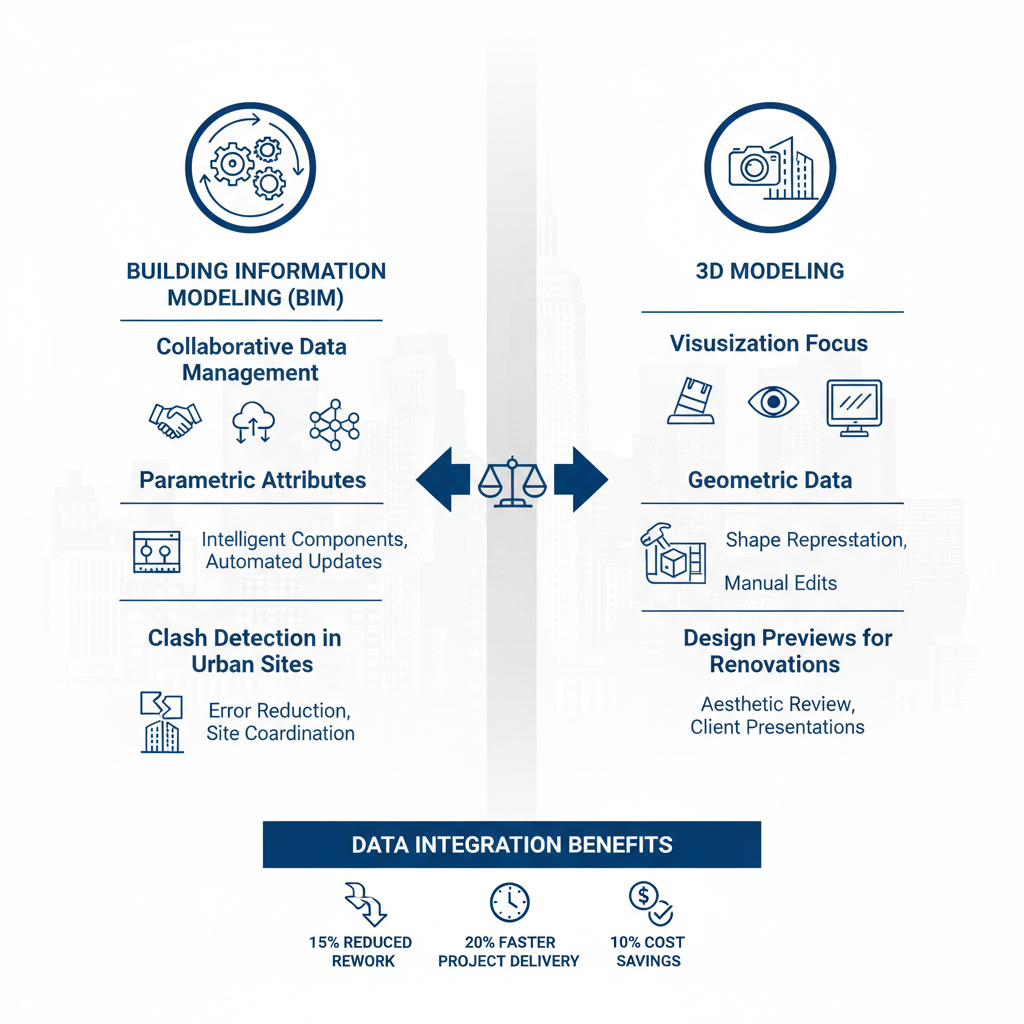
BIM vs. 3D Modeling: Key differences and benefits for NYC AEC projects
Scan-to-BIM Process Overview
The scan-to-BIM process transforms raw laser scan data into actionable BIM models through a structured workflow. It begins with on-site data capture using stationary or mobile scanners to generate point clouds, followed by registration in software like Autodesk ReCap to align multiple scans into a unified dataset. Next, modelers import the cloud into Revit, tracing elements to build intelligent objects with embedded properties.
- Field scanning: Deploy equipment to collect point data.
- Post-processing: Clean and register clouds for accuracy.
- Modeling: Convert geometry into parametric BIM components.
- Validation: Perform quality checks against tolerances like ±1mm.
This laser-based BIM development in the city addresses urban site demands, such as capturing intricate details on bridges or high-rises. In scan to BIM in New York, the process ensures models support clash-free designs, as exemplified by Arrival3D’s case studies on infrastructure projects where precise conversions reduced field revisions by identifying conflicts early.
Key Benefits of 3D Modeling and Laser Scanning for New York Construction
In the fast-paced world of urban development, 3D modeling in New York stands out as a transformative tool for construction professionals. From towering skyscrapers to intricate renovations, these technologies address the city’s unique challenges like limited space and stringent regulations. BuildScan3D leverages advanced 3D laser scanning to deliver precise data that enhances project outcomes and supports sustainable growth in this dynamic metropolis.
Enhancing Project Accuracy and Efficiency
3D laser scanning in New York revolutionizes construction by minimizing errors in densely packed urban environments. Traditional methods often lead to misalignments, but laser scanning captures millimeter-accurate point clouds, enabling clash detection early in the design phase. For instance, in projects like the Hudson Yards development, accuracy-driven modeling for urban builds prevented costly on-site adjustments by identifying interferences before pouring concrete.
Key benefits include:
- Reduced measurement errors: Up to 99% accuracy in as-built documentation, crucial for NYC’s historic preservation rules.
- Streamlined coordination: BIM-enabled project optimization in NYC allows architects and engineers to collaborate seamlessly via digital twins.
- Faster progress monitoring: Real-time scans track deviations, ensuring timelines stay on course amid the city’s tight schedules.
By integrating these tools, teams achieve higher efficiency, cutting overall project duration by as much as 15% according to industry benchmarks from local scanning experts.
Cost Savings and Risk Reduction
Adopting 3D technologies yields significant financial advantages, particularly through risk mitigation in high-stakes New York builds. Scan-to-BIM processes detect potential conflicts virtually, slashing rework expenses that plague traditional workflows. The Iscano 3D Laser Scanning Cost Guide 2025 highlights up to 20% reduction in rework costs for urban projects, a vital edge in a market where delays can escalate budgets rapidly.
Consider these numbered savings examples:
- Clash detection savings: In Brooklyn developments, early identification avoids $50,000+ in change orders per floor.
- Material optimization: Precise models minimize waste, saving 10-15% on materials for infrastructure like bridges.
- Schedule acceleration: 3d scanning brooklyn services, as offered by BuildScan3D, enable quicker approvals and reduce labor overtime by 25%.
These reductions not only protect bottom lines but also lower safety risks, fostering a more predictable path to completion in NYC’s competitive landscape.
Facility Management and Renovation Advantages
For New York property owners and managers, scan to BIM in New York provides enduring value beyond initial construction. Detailed 3D models serve as living digital assets, facilitating efficient renovations and ongoing maintenance for subways, offices, and brownstones. Arrival3D’s insights from local projects show how these scans support asset inventories, enabling proactive repairs that extend building lifespans.
Notable advantages include:
- Asset tracking: BIM models integrate with facility systems for instant access to HVAC layouts, ideal for subway infrastructure.
- Renovation ease: In a case like a Manhattan office retrofit, scan data cut planning time by 30%, avoiding disruptive fieldwork.
- Sustainability support: Accurate models aid energy audits, aligning with NYC’s green building mandates.
BuildScan3D’s Leica and Faro scanners ensure reliable deliverables, empowering managers to optimize operations and minimize downtime. Now that the value is clear, exploring the implementation process reveals how these benefits come to life.
The Step-by-Step Process of 3D Laser Scanning to BIM in New York
In the fast-paced world of architecture, engineering, and construction in New York, 3D modeling in New York has become essential for capturing complex urban structures with precision. BuildScan3D specializes in this 3D laser scanning to BIM process, transforming raw site data into actionable digital assets for projects ranging from high-rise renovations to infrastructure upgrades. This workflow ensures accuracy and efficiency, addressing unique challenges like tight urban access and variable weather. By integrating advanced tools, teams can minimize errors and accelerate timelines, ultimately influencing costs through streamlined operations.
On-Site Data Capture with Advanced Scanners
Begin the 3D laser scanning in New York by conducting a thorough site assessment to identify optimal scanner positions. For interiors of Manhattan office buildings, use stationary setups with Leica BLK360 scanners to capture detailed point clouds without disruption. In outdoor scenarios, such as Brooklyn bridge inspections, opt for weather-proof mobile scanning with Faro Focus or Navvis VLX systems to navigate congested areas safely.
- Prepare the site: Secure permissions and set up barriers, especially in high-traffic NYC zones, to ensure crew safety and compliance with local regulations.
- Position scanners strategically: Place devices for overlapping coverage, achieving millimeter accuracy even in low-light subway environments.
- Initiate scans: Run sessions lasting 10-30 minutes per station, capturing millions of points to document as-built conditions like HVAC layouts or structural elements.
- Verify initial data: Use on-site software to check for gaps, adjusting for New York’s dynamic elements like passing traffic.
This phase, tailored to urban constraints, typically takes 1-3 days depending on project scale, setting a solid foundation for subsequent modeling while prioritizing worker safety with reflective gear and traffic control.
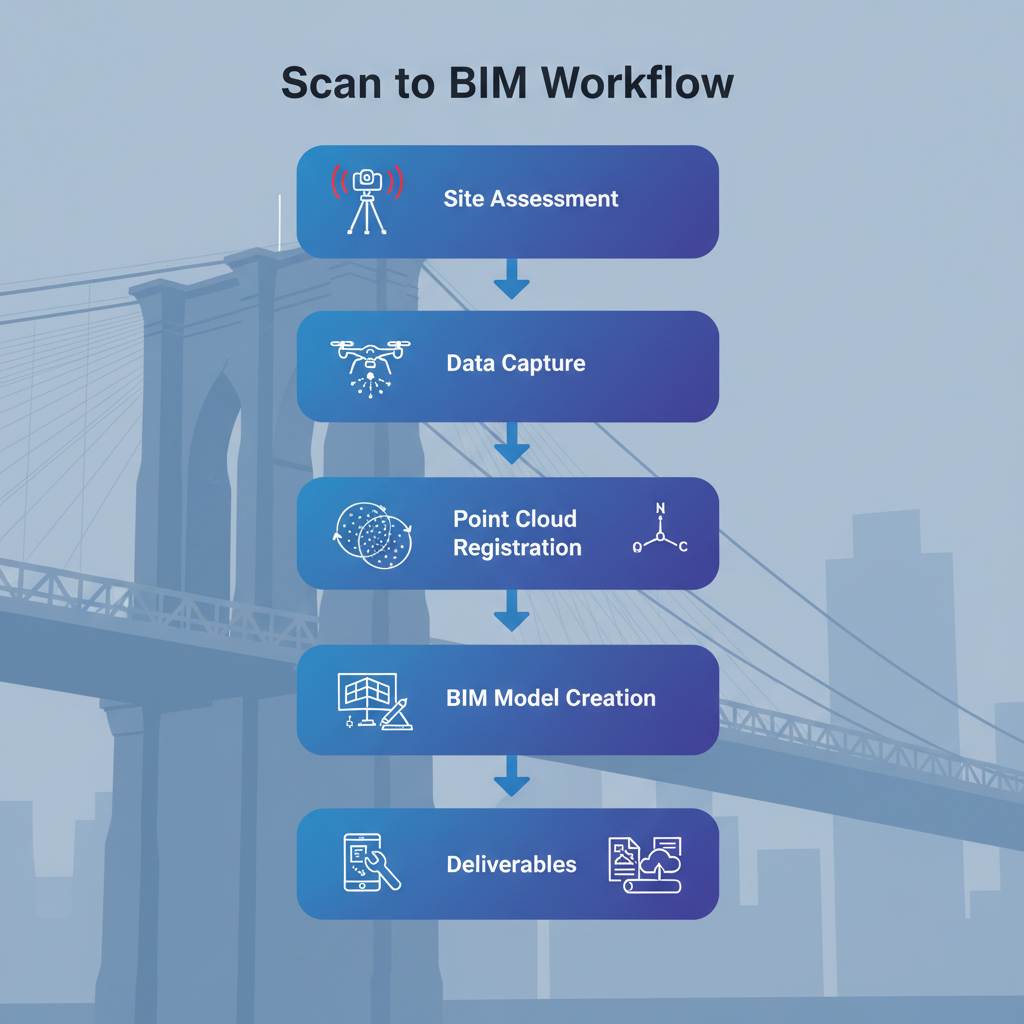
Step-by-step 3D laser scanning to BIM process for New York projects
Post-Processing and Model Creation
Once data is collected, shift to the scan to BIM in New York through meticulous post-processing to refine raw point clouds. Import scans into software like Autodesk ReCap for registration, aligning multiple datasets with sub-millimeter precision as recommended by industry guides for registration accuracy thresholds below 2mm.
- Register point clouds: Merge overlapping scans using target-based or cloud-to-cloud methods, correcting for New York’s multi-level structures.
- Clean and mesh data: Remove noise and create polygonal meshes, essential for complex geometries in urban high-rises.
- Generate BIM models: Convert meshes into Revit elements, incorporating clash detection to identify conflicts in pipe networks or elevations.
- Validate accuracy: Perform quality checks against site photos, ensuring models reflect real-world conditions like facade irregularities.
This workflow for digital surveying in NYC demands 3-7 days, depending on data volume, and leverages BIM generation from scans in urban settings to produce intelligent models ready for coordination, reducing rework costs by up to 20 percent through early issue spotting.
Deliverables and Integration into Workflows
Finalizing the process yields comprehensive deliverables that integrate directly into AEC workflows, empowering New York teams with versatile outputs. BuildScan3D provides these in formats compatible with Revit, AutoCAD, and facility management systems, supporting everything from design revisions to ongoing maintenance.
- Point cloud files (E57/PTX): High-resolution bases for further analysis, ideal for asset inventories in campus expansions.
- 2D plans and sections: Accurate floor plans with BOMA calculations, speeding up permitting in tri-state projects, including 3d scanning new jersey for cross-border sites.
- 3D Revit BIM models: Fully parametric files with LOD 300-400 detail, enabling virtual walkthroughs and clash-free coordination.
- Virtual tours and reports: Interactive 360-degree views for stakeholder reviews, plus inspection summaries for bridge or pipeline assessments.
These outputs, delivered within 1-2 weeks post-scan, facilitate smooth integration into software like Navisworks, enhancing collaboration and decision-making. To maximize these outcomes, follow best practices in the next section for optimal results in demanding New York environments.
Best Practices for Implementing 3D Scanning and BIM in New York
Implementing 3D modeling in New York requires careful planning to navigate the city’s dense urban environment and stringent regulations. By following these best practices, architecture, engineering, and construction (AEC) professionals can maximize the benefits of 3D laser scanning and BIM for projects ranging from high-rises to infrastructure upgrades. Local firms like BuildScan3D, based in White Plains, exemplify how certified services deliver accurate data for seamless integration into design workflows.
Selecting Certified Providers and Equipment
Choosing the right provider is crucial for successful strategic 3D capture in urban areas. Start by evaluating companies on their equipment certification and experience with tools like Leica or Faro scanners, which offer ±1mm accuracy essential for New York’s precise building requirements. For 3D laser scanning in New York, prioritize providers with proven track records in handling complex sites, such as those involving historic renovations or tight construction schedules.
- Verify Certifications: Ensure the team holds credentials in laser scanning technologies and BIM software, reducing errors in data processing.
- Assess Local Expertise: Select firms familiar with tri-state challenges, like navigating subway vibrations during scans.
- Review Equipment Standards: Opt for devices meeting Iscano’s best practices for high-resolution point clouds, as outlined in their 2025 cost guide.
BuildScan3D stands out with its Leica and Faro tools, providing reliable 3D laser scanning services in New York. Schedule a consultation to discuss your project’s needs and avoid pitfalls like using outdated gear that compromises accuracy.
Optimizing Workflows and Managing Costs
Efficient scan to BIM in New York demands streamlined processes to fit fast-paced city timelines. Begin with phased scanning–capture key areas first to inform early design decisions–helping control budgets amid rising material costs. According to the Iscano Laser Scanning LiDAR Best Practices guide, integrating mobile scanners for quick site passes can cut processing time by up to 30%, ideal for optimized BIM practices for tri-state projects.
- Plan Around Schedules: Coordinate scans during off-peak hours to minimize disruptions on busy NYC sites.
- Leverage Software Integration: Use tools like Revit for direct point cloud import, ensuring smooth model development.
- Budget Strategically: Allocate funds for post-processing; phased approaches prevent overruns, with average costs for medium buildings at $5-$10 per square foot per Iscano estimates.
For example, BuildScan3D’s workflow includes on-site assessment and rapid Revit deliverables, enhancing collaboration. Implement these tips to boost project efficiency and explore job opportunities in 3D modeling through partnerships with such experts. Watch for common errors like inadequate site prep, which can inflate costs by 20%. Contact local providers today for tailored advice.
Ensuring Compliance and Local Project Success
Compliance with New York regulations is non-negotiable for project approval and safety. Focus on quality checks for BIM models, verifying against Department of Buildings (DOB) standards for as-built documentation. Incorporate local tips, such as early coordination with permitting offices for infrastructure scans, to avoid delays in high-stakes environments.
- Adhere to DOB Guidelines: Ensure point clouds and models meet accuracy thresholds for filings and inspections.
- Conduct Quality Assurance: Perform regular validations on deliverables, checking for deviations that could lead to rework.
- Incorporate Safety Protocols: Use certified equipment to comply with OSHA rules during urban scanning operations.
The Iscano guide emphasizes rigorous QA to align with industry benchmarks, benefiting construction projects in NYC by reducing clashes. BuildScan3D’s White Plains location facilitates quick response for compliance-focused services, supporting various scales from small renovations to large campuses. With these practices, your New York projects can thrive–here’s the next step: reach out to certified experts like BuildScan3D for a free consultation to elevate your outcomes.
Advancing Your New York Projects with 3D Laser Scanning Expertise
In the dynamic landscape of 3D modeling in New York, leveraging advanced technologies like laser scanning transforms complex projects into streamlined successes. From towering skyscrapers in Manhattan to infrastructure upgrades across the Bronx and Brooklyn, these tools ensure precision and efficiency for architecture, engineering, and construction professionals. BuildScan3D stands at the forefront, delivering tailored solutions that capture existing conditions with unparalleled accuracy.
Recapping the essentials, 3D laser scanning in New York provides detailed point clouds and as-built data, reducing errors and accelerating workflows. The scan to BIM in New York process involves on-site data capture using certified Leica and Faro scanners, followed by post-processing into Revit-ready models and 2D plans. Benefits include significant cost savings through clash detection and progress monitoring, alongside best practices like early site assessments for optimal results. Local advantages shine in navigating New York’s unique regulatory and spatial challenges, supporting innovative 3D solutions for NYC’s urban renewal initiatives.
Key takeaways underscore the reliability of these local BIM advancements, with BuildScan3D recognized among top providers as validated by industry sources like Clutch.co. Their ±1mm accuracy minimizes rework, empowering B2B clients with deliverables like virtual walkthroughs and BOMA calculations from the White Plains office.
Ready to elevate your projects? Contact BuildScan3D today at +1 914 391 4631 or office@buildscan3d.com for a consultation. Partner with experts serving the tri-state area to achieve precise, efficient outcomes without delay.