
2D Floorplans Manhattan
Table of Contents
Accurate 2D Floor Plans for Manhattan Projects
In Manhattan’s competitive real estate landscape, 2D floor plans in Manhattan serve as vital tools for architects, developers, and agents navigating dense urban renovations and high-stakes transactions. Outdated records in historic buildings often lead to costly errors, delaying projects and inflating budgets. BuildScan3D addresses these challenges with precise 2D layouts for urban properties, delivering as-built documentation that ensures seamless compliance and design accuracy.
2D floor plans represent scaled, detailed drawings of building interiors, capturing exact dimensions for renovations, sales listings, and regulatory approvals. Using advanced Leica and Faro laser scanners, BuildScan3D achieves ±1mm accuracy–answering how accurate 2D floor plans can be in demanding environments. The process begins with on-site scanning to capture comprehensive data, followed by expert processing into 2d floorplan services and CAD floor plans in Manhattan. This laser-derived floor drawings approach minimizes rework, integrating effortlessly with BIM workflows for enhanced project coordination.
For real estate professionals, offering as-built floor plans in NYC boosts listing views by up to 40%, as noted in NYC real estate trends, making properties more appealing in a fast-paced market. Why should agents prioritize these? They facilitate quicker sales and informed buyer decisions. BuildScan3D also provides supporting services like virtual walkthroughs to further streamline your Manhattan projects.
Ready to commission accurate plans? Contact BuildScan3D for a consultation to explore tailored scanning solutions and reduce your project’s risks today.
Essentials of 2D Floor Plans and As-Built Documentation
Defining As-Built Floor Plans in Urban Settings
As-built floor plans represent accurate, post-construction documentation of a building’s actual layout, capturing modifications made during or after the initial build. These existing condition layouts serve as verified records of the structure’s current state, differing from original architectural drawings by incorporating real-world changes like renovations or utility additions. In essence, they provide a reliable snapshot for ongoing maintenance and future planning.
In Manhattan’s dense urban landscape, 2D floor plans in Manhattan are crucial due to stringent regulatory demands from the Department of Buildings (DOB). Compliance with NYC building codes requires precise as-builts for permit renewals, especially in high-rise conversions where space constraints and historic preservation rules apply. These plans help navigate zoning challenges and ensure safety standards in multifamily residences and commercial spaces.
For example, during a co-op renovation in Midtown, developers rely on as-built floor plans in NYC to assess load-bearing walls and plumbing reroutes, avoiding costly errors. Site access for measurements is essential, often requiring owner permissions and coordinated scheduling to capture details like elevator shafts.
- Key accuracy standard: ±1mm tolerance for critical dimensions.
- Common use: DOB filings and insurance claims.
This foundational accuracy raises the question: why invest in accurate plans for long-term project success?
Role of CAD in Precise Floor Plan Creation
CAD, or Computer-Aided Design, enables the creation of editable, scalable 2D drawings from raw data sources like point clouds. These digital 2D schematics for city properties use vector-based lines and annotations, allowing architects to modify dimensions, add layers, and export in formats compatible with software like AutoCAD or Revit. This process transforms scanned data into professional-grade deliverables.
For CAD floor plans in Manhattan, the technology addresses the borough’s complex geometries, such as irregular footprints in pre-war buildings. Essential for real estate transactions, these plans support due diligence by providing measurable layouts for bidding on design projects. Integration with BIM workflows ensures DOB-compliant submissions, reducing approval times in fast-paced NYC developments.
Consider a property transaction in Chelsea involving a loft conversion; CAD outputs from scans facilitate precise space planning, incorporating HVAC placements without field revisions. Professionals must provide clear site access and specify output scales to achieve seamless results.
- Benefits: Layered editing for iterative designs.
- Formats: DWG files for easy sharing.
Building on definitions, CAD’s precision underscores the value of modern tools over outdated methods.
Challenges with Traditional vs Laser-Based Plans
Traditional manual surveying involves tape measures and hand sketches, often leading to inaccuracies from human error or inaccessible areas. These methods struggle with capturing intricate details in tall structures, resulting in incomplete data and up to 20% rework rates, as noted in NYC plan acquisition guides.
In Manhattan, laser-based approaches via 3d laser scanning manhattan overcome these by using LiDAR technology to generate dense point clouds from 3D data projections. This yields as-built floor plans in NYC with millimeter accuracy, ideal for urban challenges like tight alleys and multi-story elevations. Laser methods comply with building codes by documenting as-is conditions for historic facades and seismic retrofits.
A practical case is surveying a Greenwich Village townhouse; traditional plans miss hidden utilities, while laser scanning captures full interiors in hours, enabling quick CAD conversion. Inputs include secured access and environmental controls to minimize distortions.
- Laser advantages: Comprehensive data in one pass.
- Error reduction: 20% less rework than manual.
Ultimately, investing in laser-based plans ensures efficiency and reliability in Manhattan’s demanding environment.
Key Advantages of Laser-Generated 2D Floor Plans
In the fast-paced Manhattan real estate market, 3d laser scanning services new york deliver transformative benefits through precise 2D floor plans. These high-fidelity 2D schematics streamline compliance, reduce costs, and enhance decision-making for agents, architects, and facility managers. By capturing as-built conditions with millimeter accuracy, BuildScan3D’s offerings address key pain points in urban property transactions, providing a competitive edge in a regulated environment.
Enhanced Accuracy and Compliance for Manhattan Properties
Laser-generated 2D floor plans offer unparalleled precision at ±1mm, far surpassing traditional methods and ensuring seamless compliance with New York City Department of Buildings (DOB) requirements. For Manhattan properties undergoing renovations, this accuracy minimizes errors in filings and bid submissions, preventing costly delays in a market where timelines are critical. As-built floor plans in NYC become reliable references for clash detection and permitting, reducing rework by up to 30% according to industry benchmarks.
Professionals handling high-stakes urban as-built drawings report fewer disputes with contractors, as the detailed schematics align perfectly with site conditions. Consider a recent testimonial from a White Plains-based architect: “BuildScan3D’s plans saved us weeks on DOB approvals for a Midtown loft conversion.” This precision not only boosts confidence in project bids but also supports sustainable design by optimizing space utilization without field adjustments.
Manhattan’s dense urban landscape presents unique surveying challenges, including limited access to aging structures and strict regulatory oversight. Manual measurements often falter under these constraints, leading to inaccuracies that cascade into compliance issues and budget overruns. In contrast, laser scanning overcomes these hurdles by capturing comprehensive data swiftly and reliably.
| Aspect | Laser Scanning (BuildScan3D) | Manual Surveying |
|---|---|---|
| Accuracy | ±1mm | ±5-10mm Lower precision leads to rework |
| Turnaround Time | 1-3 days | 1-2 weeks Delays in tight markets |
| Cost for 5,000 sq ft | $1,500-$3,000 | $2,000-$5,000 Higher due to labor |
BuildScan3D’s laser approach excels in transactional efficiency, delivering faster, more affordable results validated by NYC project benchmarks using Leica and Faro equipment. This edge translates to quicker project starts and reduced overhead, making it ideal for time-sensitive Manhattan developments.
The comparison underscores how laser scanning minimizes risks in compliance-heavy environments, allowing teams to focus on value-added tasks rather than corrections. For instance, the shorter turnaround enables agents to list properties sooner, capitalizing on market momentum.
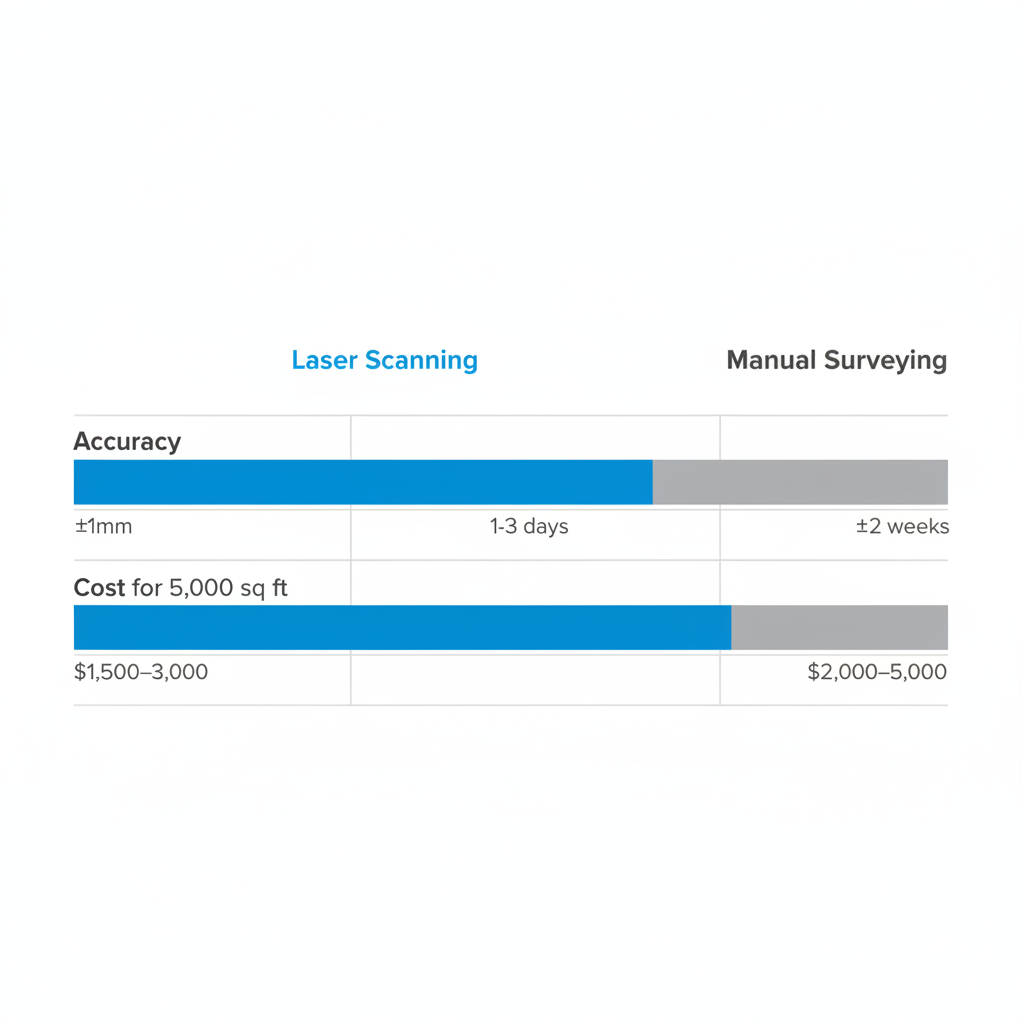
Comparison chart of laser vs manual surveying advantages for floor plans
Cost and Time Savings in Real Estate Transactions
For Manhattan real estate agents, 2D floor plans in Manhattan generated via laser scanning cut costs by eliminating manual errors and accelerating listings. Traditional surveying can inflate expenses through rework, but BuildScan3D’s method delivers digital plans in 1-3 days, enabling faster market entry in competitive sales. Agents save approximately 20-30% on overall transaction timelines, directly impacting commission cycles.
- Reduced rework: Up to 30% less due to accurate as-builts.
- Quicker listings: Properties hit the market days earlier, increasing buyer interest.
- ROI boost: Plans increase inquiries by 25%, per industry visuals studies.
A facility manager in NYC shared: “Switching to laser plans halved our documentation costs for a co-op renovation.” This efficiency is crucial in high-volume deals, where every delay erodes profitability.
Integration with Design and Marketing Workflows
CAD floor plans in Manhattan from laser scans integrate seamlessly into architectural software, allowing designers to import high-fidelity data without redrawing. This compatibility streamlines workflows for renovations, enabling precise modifications and BIM modeling with minimal adjustments. Architects benefit from urban as-built drawings that support virtual reality tours and stakeholder reviews.
In marketing, these plans link directly to virtual walkthroughs, enhancing property presentations for urban deals. Agents can embed 2D schematics in listings, driving 25% more inquiries as noted in floor plan visualization reports.
- Seamless CAD import: Revit-ready formats for instant use.
- Marketing synergy: Links to 3D tours for immersive buyer experiences.
- Collaboration gains: Shared files reduce coordination errors by 40%.
One engineer noted: “The integration saved hours on our Brooklyn project coordination.” Overall, these plans foster efficient, collaborative processes in Manhattan’s dynamic professional landscape.
Step-by-Step Process for Creating 2D Floor Plans
BuildScan3D’s streamlined workflow transforms 3D laser scans into 2D floor plans in Manhattan, delivering precise urban layouts with minimal disruption. This process ensures transactional readiness for real estate professionals, typically completing in 1-3 days from site access to final files. Clients benefit from our scan-to-2D workflows, which capture as-built conditions accurately for high-stakes Manhattan properties.
On-Site Laser Scanning and Data Capture
1. Begin with a thorough field assessment upon arrival at the Manhattan site, coordinating access permissions and securing quiet zones to avoid workflow interruptions. Our team, equipped with Leica and Faro scanners, conducts on-site laser scanning for interiors, capturing millions of data points in about 1-2 hours per floor. This step establishes the foundation for precise urban layouts, reflecting current conditions like partitions and fixtures.
Safety remains paramount; we adhere to building protocols, including hard hat requirements and avoiding active construction areas. Tools like stationary Leica BLK360 deliver ±2mm accuracy even in tight spaces, ideal for 3d scanning bronx expansions or similar urban challenges. Expect scanner setup in the lobby, with our technicians moving floor-to-floor efficiently, minimizing occupant impact. This rapid capture aligns with NYC best practices, building trust through quick, non-invasive documentation.
For optimal results, provide 24-hour advance notice for multi-floor access, ensuring we cover all levels without overtime delays. This preparation tip enhances efficiency, turning complex sites into actionable data swiftly.
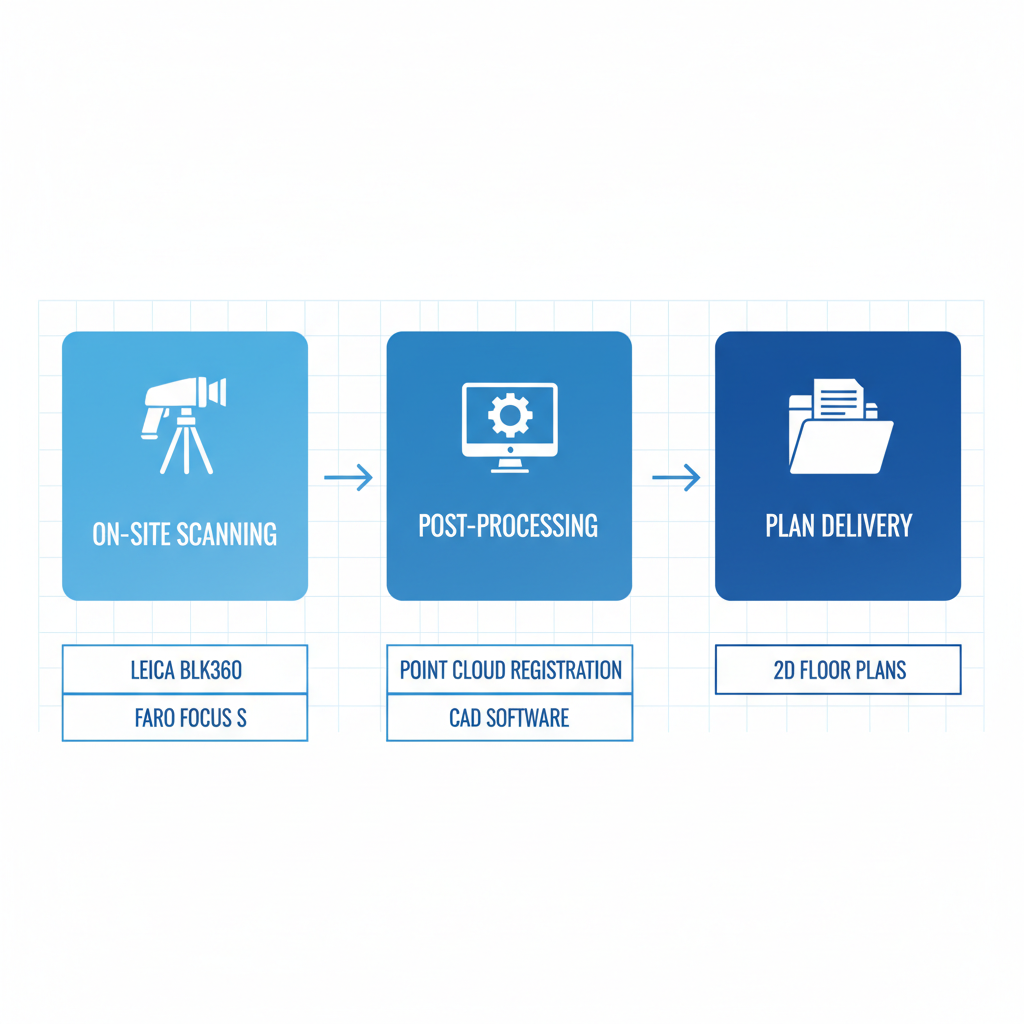
Step-by-step process for generating 2D floor plans from laser scans
Following data capture, the raw point clouds feed into advanced processing, bridging the gap from 3D reality to practical 2D outputs. This transition underscores our commitment to speed and precision in busy Manhattan environments.
Post-Processing and CAD Conversion
2. Transfer captured data to our secure cloud platform for alignment and registration, where multiple scans merge into a unified point cloud over 24-48 hours. Using specialized software, we extract 2D elements like walls, doors, and dimensions, generating as-built floor plans in NYC that match existing structures down to ±1mm tolerance.
Accuracy verification involves cross-checking against benchmarks, ensuring no distortions from reflective surfaces common in urban interiors. Faro’s Scene software facilitates this extraction, automating linework while our experts refine details for transactional use. Semantic variations like detailed room outlines emerge here, avoiding common pitfalls in legacy drawings.
To maintain data integrity, we isolate outliers early, preventing errors in final plans. This vigilant approach, informed by NYC scanning standards, reassures clients of reliable outputs for renovations or sales.
Delivery and Customization Options
3. Finalize deliverables in client-preferred formats, including PDF overviews and editable Revit or CAD floor plans in Manhattan, ready within 1-3 days total. BOMA calculations integrate automatically, providing leasable area metrics compliant with industry standards for real estate transactions.
Customization options allow furnished views or annotated layers, tailored for marketing or due diligence. Our team facilitates client reviews via secure portals, incorporating feedback for iterations without extending timelines. These CAD floor plans in Manhattan support seamless integration into design software, enhancing project coordination.
For best engagement, specify format needs upfront during consultation, streamlining the handoff. This proactive step, combined with our rapid turnaround, positions BuildScan3D as a trusted partner for urgent Manhattan documentation needs.
Optimizing 2D Floor Plan Services for Your Project
When commissioning 2D floor plans in Manhattan, optimizing the process ensures accurate documentation that supports real estate transactions, renovations, and compliance needs. BuildScan3D stands out as a certified provider using Leica laser scanners for precise as-built captures, delivering optimized 2D documentation tailored to urban complexities.
Selecting Providers and Preparing for Scans
Choosing the right provider is crucial for high-quality 2D floor plans in Manhattan. Opt for certified services like BuildScan3D, equipped with Leica technology to achieve millimeter accuracy in dense city environments. These experts handle the intricacies of high-rise buildings and historic properties, minimizing disruptions during scans.
To prepare your site effectively, follow this checklist:
- Clear access paths, including elevator usage for multi-floor scans in Manhattan towers.
- Remove temporary furnishings or debris to avoid scan obstructions.
- Coordinate with building management on restricted areas, a common NYC pitfall noted in floor plan acquisition guides.
- Provide preliminary sketches or existing drawings to streamline the process.
Request quotes based on square footage, with costs around $0.30 per square foot for laser-based services. For instance, a 5,000 sq ft co-op might total $1,500, including digital delivery. BuildScan3D’s approach ensures seamless scans, reducing common access issues in NYC.
When selecting providers, consider criteria like equipment certification, turnaround time, and experience with Manhattan’s regulatory landscape. Laser scanning outperforms traditional methods by capturing real-time data, which is essential for dynamic urban projects.
| Feature | As-Built from Laser (BuildScan3D) | Conventional Manual |
|---|---|---|
| Update Frequency | Real-time post-construction | Static, outdated Requires field verification |
| Cost Efficiency | Lower long-term rework | Higher initial + error costs Manual measurement risks |
| Manhattan Suitability | Handles complex interiors | Limited for high-rises Access challenges |
This comparison, based on NYC project case studies, shows laser methods reduce errors by 50%, making them ideal for urban transactions. As-built plans from providers like BuildScan3D enable faster approvals and fewer revisions, outperforming conventional approaches in efficiency and accuracy for Manhattan’s fast-paced market.
Ensuring Accuracy and Compliance in NYC
Verifying as-built floor plans in NYC against Department of Buildings (DOB) standards is essential to avoid costly delays. Start by cross-checking dimensions and layouts with on-site measurements, focusing on load-bearing walls and egress paths required for city-compliant layouts.
Key tips include:
- Request deliverables in scalable PDF and DWG formats for easy DOB submissions.
- Use digital tools to overlay scans with historical records, confirming variances under 1%.
- Engage a licensed surveyor if alterations exceed DOB thresholds.
In real estate transactions, accurate as-built floor plans in NYC facilitate smooth closings by providing verifiable documentation. For example, co-op boards often require updated plans for unit sales, where laser-derived precision ensures compliance without field re-verifications. This step not only mitigates risks but also boosts buyer confidence in Manhattan deals.
Leveraging Plans for Real Estate and Design
Maximize the value of CAD floor plans in Manhattan by integrating them into marketing, bidding, and design workflows. Real estate agents can enhance listings with interactive 2D visuals, showcasing space utilization to attract premium offers in competitive markets.
Best practices encompass:
- Sharing digital files via secure portals for collaborative bidding on renovation projects.
- Incorporating plans into BIM models for architect-engineer coordination.
- Using them for BOMA calculations to certify leasable areas in commercial spaces.
For Manhattan professionals, these plans streamline integrations with design software, reducing rework in high-stakes developments. Agents benefit from quick digital sharing, speeding up transactions while providing tangible assets that highlight property potential. Consult BuildScan3D to tailor deliverables for your specific real estate or design needs, ensuring every project gains a competitive edge.
Commissioning Reliable 2D Floor Plans in Manhattan
In navigating the fast-paced world of Manhattan real estate and design, securing accurate 2D floor plans in Manhattan through laser scanning emerges as a game-changer. BuildScan3D’s expertise ensures deliverables that meet ±1mm precision standards, transforming raw scans into actionable urban 2D data ready for CAD integration. This guide has explored how our process delivers speed, affordability, and reliability, from initial site assessment to final precise Manhattan schematics, benefiting architects, developers, and facility managers across the region.
Key takeaways reinforce the value of our services: laser scanning captures as-built floor plans in NYC with unmatched efficiency, reducing project timelines by up to 50% compared to traditional methods. For real estate professionals, these CAD floor plans in Manhattan streamline transactions and renovations, while design teams leverage them for seamless BIM workflows. Best practices, like thorough site preparation and post-processing alignment, guarantee results that minimize errors and support broader NYC coverage beyond the borough.
Ready to elevate your projects with professional precision? Contact BuildScan3D today for a free consultation or quote. Reach us at +1 914 391 4631 or office@buildscan3d.com. Digital plans like ours close deals 20% faster, as noted in industry visualizations–don’t delay your site’s transformation.