
3D Scanning Company New York
Table of Contents
Discovering 3D Scanning Companies in New York
In the heart of bustling urban development, finding a reliable 3D scanning company in New York is essential for professionals tackling complex projects. These firms leverage advanced laser technology to capture precise digital representations of physical spaces, ensuring millimeter-accurate data for architecture, engineering, and construction workflows. With New York City’s dense skyline and historic districts demanding unparalleled accuracy, local providers like BuildScan3D stand out for their expertise in Manhattan, Brooklyn, and beyond.
3D scanning uses laser-based methods to create detailed point clouds with ±1mm accuracy, ideal for New York’s challenging environments such as high-rise constructions and preserved buildings. Top New York-based 3D laser firms employ equipment like Leica, Faro, and Navvis scanners to generate 3d laser scanning manhattan services in NYC, addressing urban scanning hurdles where traditional methods fall short. As noted in industry insights, dense cityscapes amplify the need for precise as-built documentation, reducing rework by up to 30% in AEC projects through BIM conversion services for NYC projects.
This guide explores the benefits of 3D laser scanning services in NYC, from scan to BIM in New York processes to best practices for facility managers and contractors. Serving a business-to-business model, these services streamline coordination and virtual walkthroughs, minimizing errors in renovation and expansion efforts across boroughs.
Ready to elevate your project? Contact BuildScan3D at their White Plains office (914-391-4631 or office@buildscan3d.com) for certified solutions tailored to your New York needs. Dive deeper into our sections to discover how precise scanning transforms your workflows.
Understanding 3D Scanning in New York
In the bustling urban environment of New York City, 3D scanning has become indispensable for capturing precise digital representations of complex structures. This technology enables architects, engineers, and contractors to document existing conditions with millimeter accuracy, supporting everything from renovations to new high-rise developments across boroughs like Manhattan and Brooklyn.
Key Technologies and Equipment Used
A leading 3D scanning company in New York relies on advanced laser scanners to navigate the city’s dense and historic environments. Key technologies include LiDAR (Light Detection and Ranging), which uses laser pulses to measure distances and create detailed point clouds. Methods range from stationary setups for fixed-site precision to mobile systems for dynamic scans in tight urban spaces.
Primary equipment features scanners from Leica, Faro, and Navvis, tailored for NYC projects. The Leica BLK360 offers a range up to 60 meters with scan speeds of 1 million points per second, ideal for capturing intricate details in high-rises without disrupting workflows. Faro Focus models provide portability and accuracy within 2 millimeters at 10 meters, perfect for mobile applications in crowded areas. Navvis VLX carts enable indoor-outdoor scanning at up to 5,000 square meters per hour, supporting rapid data collection for 3d scanning bronx sites. These tools from 3D laser scanning services in NYC ensure high mobility and efficiency amid the city’s fast-paced construction demands.
- Leica RTC360: High-speed capture with 2 million points per second, range of 130 meters.
- Faro Focus S: Sub-millimeter accuracy, lightweight for elevated or confined scans.
- Navvis Hardware: Integrated SLAM for real-time mapping in subways or brownstones.
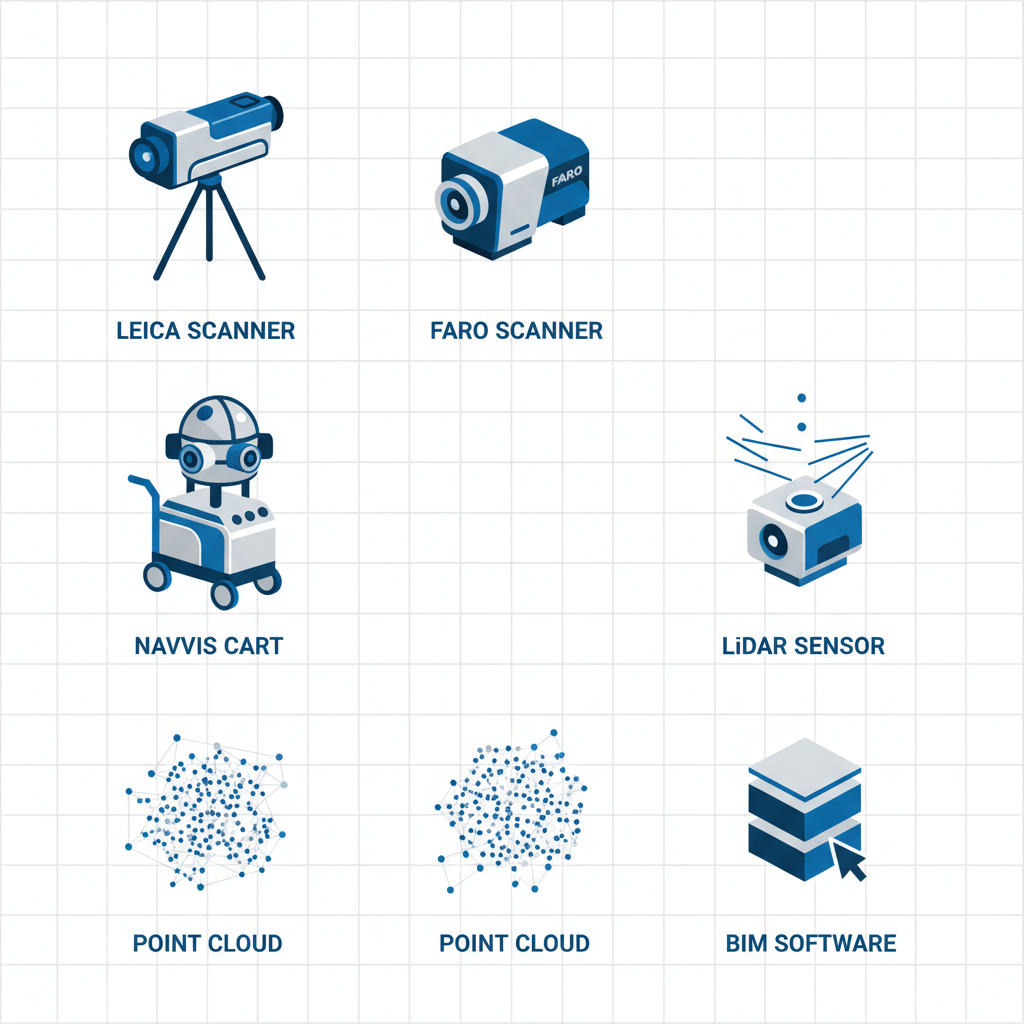
Icons of essential 3D scanning tools for urban construction in New York
Icons of essential 3D scanning tools for urban construction in New York
These technologies allow NYC laser capture firms to deliver comprehensive datasets, transforming raw scans into actionable insights for local builds.
Applications in Urban Architecture and Construction
3D scanning addresses New York-specific challenges, such as high-density developments and renovations of landmark buildings. In architecture, it facilitates existing conditions assessment by generating accurate as-built models, reducing errors in redesigns for structures like Brooklyn’s historic bridges.
For construction, the technology excels in clash detection, identifying conflicts between new elements and existing infrastructure before pours or installations. In Manhattan’s skyscrapers, mobile scanners map tight mechanical rooms, while stationary units document facades during phased renovations. BIM digitization for New York builds integrates these scans to streamline coordination among multidisciplinary teams, minimizing rework in time-sensitive projects. Urban applications also include progress monitoring for subway expansions and asset inventories for property owners, ensuring compliance with stringent city codes.
Examples abound in Brooklyn’s adaptive reuse projects, where scanning supports seismic retrofits without halting operations. Overall, these uses enhance efficiency in navigating the city’s vertical and constrained landscapes.
Accuracy Standards for Local Projects
Precision is paramount in New York workflows, with industry standards targeting ±1mm accuracy for critical applications. Certified providers achieve this through calibrated equipment and post-processing software, meeting benchmarks set by bodies like the American Society of Photogrammetry and Remote Sensing.
This level of detail is essential for scan to BIM in New York, where point clouds convert seamlessly into Revit models for design validation. Implications include faster permitting processes in Manhattan, as accurate models align with DOB requirements, and reduced liability in Brooklyn renovations. LiDAR performance in urban settings, as noted in state-wide benchmarks, maintains sub-millimeter fidelity even amid reflective glass towers or vibrating construction sites.
For high-stakes projects like bridge inspections, ±1mm ensures structural integrity analysis without field measurements. Local firms prioritize certified hardware to deliver reliable data, fostering trust in BIM integration and supporting sustainable urban growth across the boroughs.
Benefits of 3D Laser Scanning Services in NYC
Engaging a 3D scanning company in New York delivers significant value for construction and architecture projects, particularly in the demanding urban environment of the city. These services provide precise data that supports clash detection, enhances BIM modeling, and accelerates timelines, addressing the unique challenges of sites like Manhattan high-rises and Brooklyn renovations. Providers such as BuildScan3D, based in White Plains, offer accessible solutions that integrate seamlessly into local workflows, ensuring compliance with New York’s strict building codes.
Enhanced Accuracy and Reduced Rework
3D laser scanning services in NYC achieve remarkable precision, often at ±1mm levels, which minimizes measurement errors that plague traditional methods. This NYC precision scanning advantage allows teams to capture as-built conditions with unparalleled detail, reducing the likelihood of costly rework during renovations or new builds. For instance, in a Manhattan office tower project, accurate scans prevented misalignments in structural elements, saving weeks of adjustments.
Key benefits include:
- Error reduction up to 30%: Detailed point clouds eliminate guesswork, ensuring components fit perfectly on the first try.
- Compliance assurance: Scans support adherence to local codes, avoiding fines from inaccuracies in historical building updates.
- Field efficiency: On-site data collection takes hours, not days, allowing faster progression in tight urban schedules.
These features prove essential for New York contractors handling complex sites, where even small discrepancies can escalate expenses. BuildScan3D’s use of Leica and Faro scanners exemplifies how such technology transforms precision into practical gains.
Streamlined Coordination for Architects and Contractors
Scan to BIM in New York facilitates superior collaboration by converting raw scan data into interactive models that architects and contractors can navigate virtually. This integration enables early clash detection, identifying conflicts in HVAC, plumbing, and electrical systems before construction begins. Local teams benefit from shared digital platforms that enhance communication, particularly in multi-stakeholder projects common to the city’s skyline.
Impacts on workflows are profound:
- Virtual walkthroughs: Stakeholders review designs in 3D, spotting issues remotely to cut site visits.
- Asset inventories: Comprehensive documentation tracks elements like fixtures, aiding subcontractors in Brooklyn warehouse conversions.
- BIM benefits for New York pros: Models in Revit format streamline approvals and reduce coordination delays by 25%.
In one Brooklyn renovation, this approach resolved interdisciplinary clashes upfront, preventing on-site disruptions. Services from firms like BuildScan3D ensure that New York projects maintain momentum, fostering efficiency amid dense urban coordination demands.
Cost and Time Savings in Urban Projects
Urban projects in NYC gain substantial ROI from 3D scanning through accelerated documentation and improved facility management. Rapid on-site scans replace labor-intensive manual measurements, compressing timelines by up to 20% and lowering overall labor costs. For facility managers, deliverables like BOMA calculations provide accurate space assessments, optimizing leasing and maintenance budgets in high-value properties.
Real-world metrics highlight the value:
- Time compression: Scans complete in hours versus days, freeing crews for critical tasks in fast-paced Manhattan developments.
- Rework reductions: Precision data cuts change orders by 30%, as seen in New York high-rise retrofits, per industry case studies.
- Long-term savings: BIM-integrated models support ongoing management, reducing operational costs over a building’s lifecycle.
A notable example involves a White Plains-accessible provider aiding a Tribeca facility upgrade, where scanning expedited HVAC modeling and ensured code compliance. These efficiencies not only control budgets but also enhance project viability in New York’s competitive construction landscape.
How 3D Scanning Works for Construction Projects
In the fast-paced world of construction in New York City, a 3D scanning company in New York streamlines project documentation by capturing precise as-built conditions. This process involves three key stages: on-site data collection, post-processing for model creation, and delivery of integrated outputs. Tailored to urban challenges like dense Manhattan sites and permit requirements in the Bronx, these New York scan workflows ensure accuracy and efficiency. BuildScan3D employs advanced Leica and Faro scanners to generate point clouds with millimeter precision, reducing errors in design and construction phases.
On-Site Data Collection Process
The on-site data collection begins with a field assessment to evaluate site conditions, typically taking 1-2 hours per location as outlined in the 2025 3D Laser Scanning Cost Guide. Technicians from a 3D scanning company in New York set up stationary or mobile scanners, such as Leica BLK360 or Faro Focus, positioning them strategically to cover tight urban spaces without disrupting ongoing work. Safety protocols are critical in NYC environments, including wearing high-visibility gear and coordinating with site managers to avoid hazards from elevated structures or traffic in areas like Brooklyn.
Execution follows a structured sequence. First, the scanner captures millions of data points per second, creating a raw point cloud of the existing structure. For 3D laser scanning services in NYC, multiple scans from various angles ensure comprehensive coverage, accounting for complex geometries in high-rises or historic buildings. This phase lasts 2-4 hours for a standard floor, depending on site size, with real-time previews allowing adjustments for optimal data quality. In permit-heavy New York projects, this quick setup minimizes downtime while adhering to local regulations.
Post-Processing and Model Creation
Post-processing relies on specialized software like Autodesk ReCap or Faro Scene for aligning and registering scan data. BuildScan3D’s team imports raw point clouds from Leica and Faro devices, using automated algorithms to stitch overlapping scans into a unified model, achieving sub-millimeter accuracy essential for BIM processing in NYC.
The steps unfold methodically. 1. Registration merges individual scans by identifying common features, eliminating distortions from site vibrations. 2. Cleaning removes noise such as reflections from glass facades common in Manhattan developments. 3. Alignment orients the model to project coordinates, preparing for conversion. For scan to BIM in New York, the process advances to Revit modeling, where points are traced into intelligent 3D elements like walls and HVAC systems. Clash detection identifies conflicts early, saving time on revisions for tight urban deadlines. This phase, spanning 1-3 days, transforms raw data into actionable BIM files tailored to New York construction timelines.
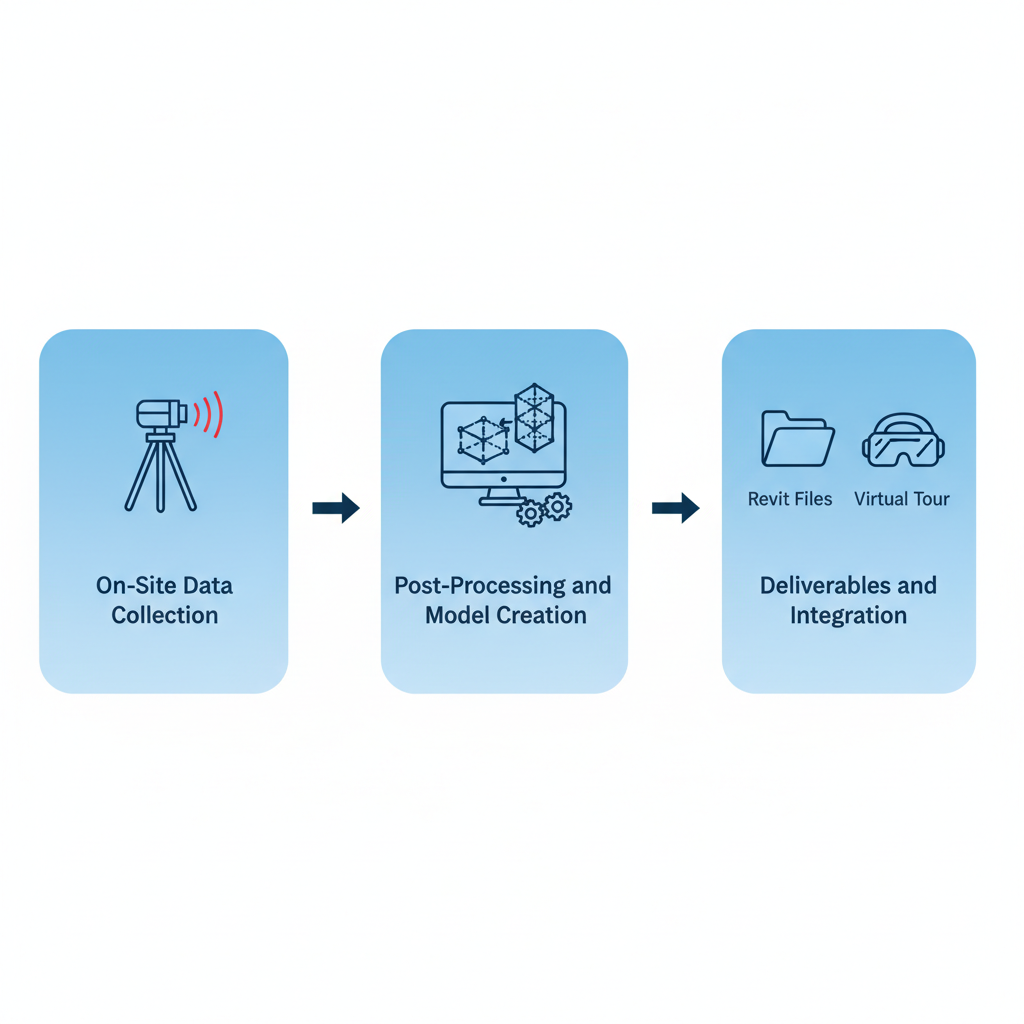
Step-by-step 3D scanning workflow for construction projects
Step-by-step 3D scanning workflow for construction projects
The diagram above visualizes how these stages interconnect, highlighting the transition from field capture to digital integration. In practice, this ensures seamless handoff to design teams, with tools like NavVis for mobile scanning adding efficiency in dynamic sites.
Deliverables and Integration
Final deliverables from 3D scanning include versatile formats suited to NYC workflows. Common outputs encompass E57 point clouds for verification, Revit BIM files for modeling, and 2D CAD plans for permitting. BuildScan3D also provides virtual walkthroughs using software like Matterport, enabling remote inspections crucial for Bronx facility managers navigating space constraints.
Integration extends these into practical applications. For instance, BIM-ready Revit files support clash detection and coordination among architects and contractors, while BOMA reports calculate area measurements compliant with New York standards. Virtual tours facilitate stakeholder reviews without site visits, ideal for post-pandemic collaboration. In construction projects, these assets reduce rework by 20-30 percent, as validated by city-specific examples from laser scanning in New York City. Facility managers use them for asset inventories and maintenance planning, ensuring long-term value. To initiate, contact local providers for consultations, extending services like 3d scanning new jersey for regional projects.
Best Practices for Scan to BIM in New York
Implementing scan to BIM processes in New York requires tailored strategies to navigate the region’s dense urban environment and strict regulations. From high-rise developments in Manhattan to renovations in the Bronx, these best practices help construction teams and facility managers streamline workflows, reduce errors, and ensure project success. By focusing on local expertise, efficient budgeting, and rigorous quality controls, professionals can harness 3D laser scanning to create accurate Revit models for design and maintenance.
Selecting Certified Local Providers
Choosing the right provider is crucial for successful scan to BIM projects in New York. Start by verifying certifications such as Leica-trained teams or ASPE memberships, which guarantee adherence to industry standards. Look for a 3D scanning company in New York with proven experience in handling complex urban sites, including familiarity with borough-specific challenges like those in the Bronx or White Plains.
To vet potential partners effectively:
- Review portfolios for NYC projects, prioritizing firms with at least five years of local operations.
- Check client testimonials and references from similar builds, focusing on delivery speed and accuracy.
- Schedule consultations to discuss equipment like Faro or NavVis scanners.
BuildScan3D, based at 222 Bloomingdale Road, Suite 404, White Plains, NY 10605, exemplifies such expertise–contact them at +1 914 391 4631 or office@buildscan3d.com for tailored advice. These steps minimize risks and align providers with your project’s needs, ensuring seamless integration from scan to BIM deliverables.
Optimizing Costs and Timelines
New York projects demand efficient resource allocation due to tight deadlines and high operational costs. Factor in variables like site size and complexity when budgeting for 3D laser scanning services in NYC; typical rates range from $5 to $15 per square foot based on 2025 benchmarks, with premiums for high-density areas.
Practical tips to control expenses and schedules include:
- Conduct pre-scan site assessments to define scope, avoiding unnecessary data capture.
- Opt for phased scanning over full-site efforts, targeting 2-4 weeks for end-to-end processing.
- Negotiate bundled services for point cloud to Revit modeling to reduce overall fees.
In fast-paced environments like Manhattan developments, these NYC BIM optimization strategies prevent delays from permitting hurdles. Early planning with local firms ensures timelines align with construction phases, delivering value without compromising precision.
Ensuring Compliance and Quality
Maintaining high standards is non-negotiable for scan to BIM in New York, where building codes emphasize safety and accuracy. Aim for ±1mm precision through data validation protocols, integrating scans with Revit for compliance with local standards like those from the NYC Department of Buildings.
Key steps for quality assurance involve:
- Implementing secure data handling to protect sensitive project information under New York privacy laws.
- Performing post-processing checks for alignment and clash detection in BIM models.
- Collaborating with certified teams to verify outputs against as-built conditions.
These New York scan quality tips address B2B concerns like rework in facility upgrades. By prioritizing validation and secure integration, teams achieve reliable digital twins that support long-term asset management and regulatory approvals.
Choosing the Right 3D Scanning Provider in New York
Selecting a reliable 3D scanning company in New York can transform your architecture and construction projects by delivering precise as-built data that streamlines workflows and minimizes errors. As highlighted throughout this guide, partnering with certified local providers ensures access to advanced 3D laser scanning services in NYC tailored for the city’s dynamic needs.
Key benefits include exceptional accuracy of ±1mm using equipment like Faro and Leica scanners, which reduce rework costs by up to 30% and accelerate timelines for Manhattan, Brooklyn, and White Plains developments. Top NYC 3D firms offer comprehensive deliverables such as point clouds, Revit BIM models, and virtual walkthroughs, typically completed within 1-4 weeks depending on project scale. These New York BIM specialists emphasize affordable options, with scans starting at competitive rates that fit tight budgets while maintaining high standards for construction progress monitoring and clash detection.
Empower your next project by contacting BuildScan3D, a trusted leader in scan to BIM in New York. Reach out for a free consultation at 222 Bloomingdale Road, Suite 404, White Plains, NY 10605; call +1 914 391 4631; or email office@buildscan3d.com. Schedule today to experience efficient, precise scanning that drives success in the heart of the metro area.
