
3D Scanning New Jersey
Table of Contents
Exploring 3D Scanning in New Jersey
3D scanning in New Jersey revolutionizes how professionals capture precise digital representations of physical spaces. This technology, known as 3D laser scanning in New Jersey, uses laser beams to emit light pulses that reflect off surfaces, measuring distances to generate detailed point clouds. These point clouds form accurate 3D models, essential for industries like architecture, engineering, and construction in the state’s varied urban and industrial settings.
Key benefits include millimeter-level accuracy, as noted by Artec3D experts who highlight how laser reflection principles enable sub-millimeter precision in complex environments. This reduces errors during renovations, streamlines workflows for BIM integration, and surpasses traditional surveying methods for intricate New Jersey projects. Mobile 3D scanning services in New Jersey provide onsite convenience across urban and rural areas, ensuring efficient laser-based 3D capture in NJ.
These foundational advantages set the stage for exploring local applications and availability in upcoming sections.
3D Scanning Applications Across New Jersey
New Jersey’s diverse landscapes, from bustling urban centers to expansive industrial ports, make 3D scanning in New Jersey an essential tool for architecture, construction, and engineering projects. This technology captures precise as-built conditions, supporting renovations in historic Newark high-rises or inspections along the Hudson River infrastructure. Unlike traditional blueprints, which often miss hidden utilities and lead to measurement errors, 3D scanning provides comprehensive digital models that streamline compliance with state regulations and accelerate project timelines.
The state’s varied geography influences how 3D scanning applications unfold across urban, suburban, and industrial areas. Urban zones demand precision amid density, suburban sites benefit from efficient surveys, and industrial locations prioritize safety in hazardous environments.
| Area Type | Common Project Types | Key Challenges | Benefits of 3D Scanning | Accuracy Requirements |
|---|---|---|---|---|
| Urban (e.g., Newark) | High-rise renovations, historic building documentation | Tight access, dense environments | Precise clash detection, reduced downtime in occupied spaces | ±1mm |
| Suburban (e.g., Princeton) | Residential expansions, educational facilities | Variable site conditions, weather exposure | Efficient site surveys, faster permitting with digital models | ±2mm |
| Industrial (e.g., Port of NJ) | Pipeline networks, bridge assessments | Hazardous areas, large-scale structures | Safety improvements, asset inventory for maintenance | ±1mm |
This comparison highlights how 3D scanning services in New Jersey adapt to regional needs, offering benefits like cost savings and reduced rework. For instance, in urban settings, it enables virtual walkthroughs for BIM integration, while industrial applications ensure accurate asset inventories. Data from local trends, including GP Radar examples, show a 30% reduction in rework compared to traditional as-built plans, which often suffer from inaccuracies in complex NJ structures.
Such adaptations underscore the value of regional 3D capture solutions in NJ, particularly when contrasting 3D laser scanning in New Jersey with outdated methods. Traditional blueprints fail to document evolving site conditions, leading to costly errors, whereas laser modeling delivers point clouds for statewide laser modeling for projects, enhancing efficiency and safety. These advantages drive demand for onsite providers, paving the way for accessible service availability across the state.
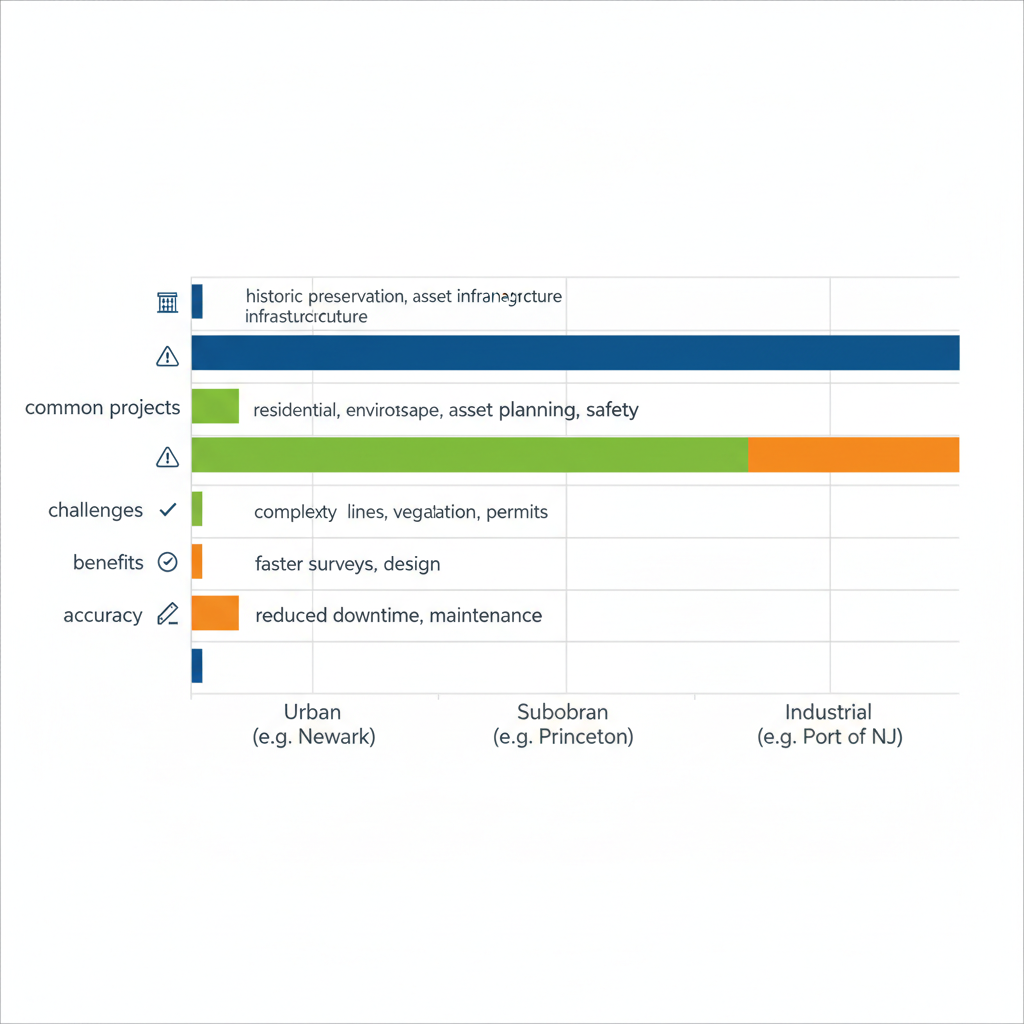
3D scanning applications comparison across New Jersey area types
3D scanning applications comparison across New Jersey area types
By addressing New Jersey’s unique challenges, from dense retrofits to regulatory demands, 3D scanning fosters informed decision-making for local professionals and property owners alike.
Accessing 3D Scanning Services in New Jersey
New Jersey’s construction and facility management sectors benefit from a robust network of providers offering 3D scanning services. Leading NJ-based 3D capture providers utilize advanced equipment like Leica and Faro scanners to deliver precise data capture for diverse projects. These services include both mobile and stationary options, allowing flexibility for on-site applications in architecture, engineering, and infrastructure development. With a focus on high-accuracy deliverables such as point clouds and BIM models, professionals can streamline workflows and reduce errors in design phases.
Coverage for 3D scanning in New Jersey spans key counties including Bergen, Essex, and Monmouth, ensuring accessibility for urban and suburban sites alike. Local laser scanning options extend statewide, with many 3D scanning services in New Jersey providing mobile units that travel to remote locations or dense city environments. This onsite capability addresses urgent needs, such as same-day responses for construction progress monitoring, and supports applications like LiDAR scanning for architectural documentation. Providers often cover extended travel radii within the state, making it feasible to service projects from coastal areas to inland facilities without delays.
Selecting the best 3D laser scanning in New Jersey involves evaluating key criteria to match project requirements:
- Certification in scanning technologies and adherence to industry standards for accuracy.
- Rapid response times, ideally within 24-48 hours, to accommodate tight schedules.
- Comprehensive BIM deliverables, including Revit files and virtual models, tailored for facility management.
By prioritizing these factors, architects and contractors can partner with reliable local options, enhancing project efficiency across New Jersey’s varied landscapes.
Key Factors for 3D Scanning Projects in New Jersey
When planning 3D scanning projects in New Jersey, several local factors influence success and efficiency. The state’s diverse urban and coastal environments demand tailored approaches to capture accurate data for construction, infrastructure, and environmental assessments.
Costs for 3D scanning in New Jersey vary based on project scale and required accuracy. For instance, building information modeling (BIM) applications typically range from $5 to $15 per square foot, depending on complexity and site access challenges in areas like Newark or Jersey City. NJ project-specific 3D solutions must account for these variables to ensure budget alignment, with larger initiatives benefiting from economies of scale.
In construction applications, 3D laser scanning in New Jersey excels at progress monitoring and clash detection, reducing errors in high-stakes developments such as highway expansions or high-rise builds. According to industry insights, these methods can cut project timelines by up to 20%, allowing teams to visualize as-built conditions in real time and avoid costly rework. Local examples include scanning for urban revitalization projects in Trenton, where precise documentation supports seamless coordination among architects and contractors.
Technological considerations highlight the advantages of local LiDAR applications and point cloud generation for New Jersey’s infrastructure, like bridges over the Delaware River or pipelines along the coast. 3D scanning services in New Jersey leverage LiDAR for millimeter-level accuracy, essential for regulatory compliance with the New Jersey Department of Environmental Protection (NJDEP) during environmental scans, such as those addressing coastal erosion. Point clouds provide detailed 3D representations that integrate into design software, enhancing safety and planning for aging facilities in regions like Atlantic City.
Beginning Your 3D Scanning Initiative in New Jersey
Starting local 3D projects in NJ requires a structured approach to ensure efficiency for architecture and construction firms. Begin by evaluating your needs for 3D scanning in New Jersey, focusing on applications like facility management and design coordination. This initial phase sets the foundation for seamless integration into your workflows.
Contacting Providers for Quotes
Reach out to professional 3D scanning services in New Jersey to initiate consultations. Schedule a call with experts like BuildScan3D to discuss project scope, timelines, and deliverables. Request quotes tailored to your B2B requirements, including on-site assessments and sample work. This step clarifies costs and aligns services with NJ-specific regulations.
Scan-to-BIM Workflow
The initial Scan-to-BIM in the state involves capturing point clouds using advanced tools, then processing them into Revit models. 3D laser scanning in New Jersey generates accurate as-built data, enabling virtual tours and clash detection. From data collection to model refinement, this workflow supports precise architecture applications and reduces rework.
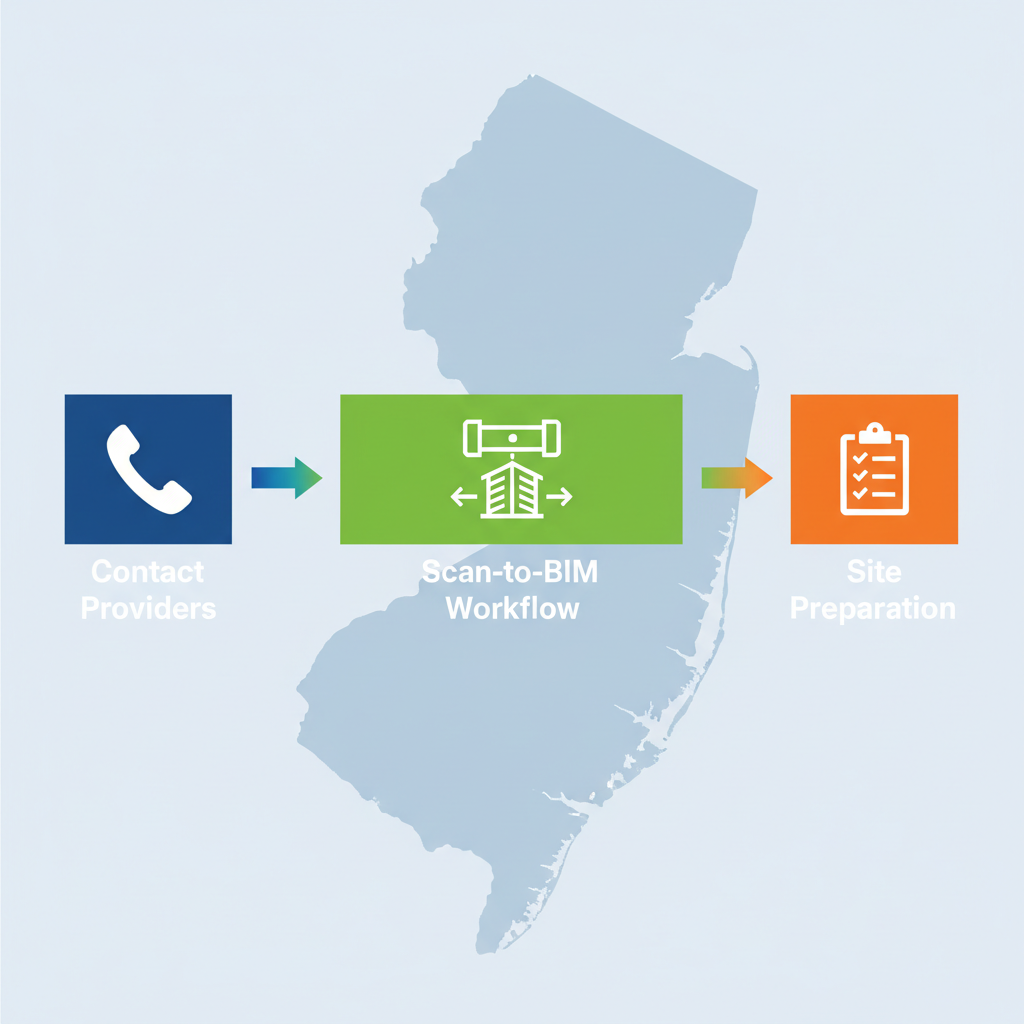
Three-step process to begin 3D scanning initiatives in New Jersey
Three-step process to begin 3D scanning initiatives in New Jersey
Site Preparation Tips
Prepare your site by securing access permissions and coordinating with local authorities for NJ permitting notes. Clear obstacles to allow unobstructed scanning paths, and notify stakeholders about scheduled visits. These measures enhance safety and data quality, streamlining execution for facility management projects.
Advancing Projects with 3D Scanning in New Jersey
Embracing 3D scanning in New Jersey transforms construction and design projects with unmatched accuracy and efficiency for local buildings. Key advantages include reduced rework and enhanced coordination through 3D laser scanning in New Jersey and comprehensive 3D scanning services in New Jersey. This NJ 3D solutions summary highlights statewide scanning advantages, like onsite services and Scan-to-BIM options that streamline workflows.
As MultiVista notes, such technologies boost overall ROI by minimizing errors. Consult local providers today for custom quotes and propel your projects forward with precision.
