
3D Building Scanning Nyc
Table of Contents
Discover 3D Building Scanning in New York City
In the bustling skyline of New York City, 3D building scanning in New York City emerges as a game-changer for construction and facility management. This advanced technology captures intricate urban structures with precision, addressing the challenges of dense high-rises and historic facades through non-invasive methods.
3D laser scanning services in New York City utilize LiDAR and terrestrial scanners, such as Leica and Faro static systems combined with NavVis mobile platforms from BuildScan3D, to generate millimeter-accurate point clouds–creating perfect digital twins for complex environments. The scan to BIM in New York City process transforms these scans into actionable Revit models, enabling seamless design coordination and reducing fieldwork by up to 30%, as industry reports on digital transformation highlight.
This laser-based building capture in NYC empowers architects, contractors, and managers to visualize virtual walkthroughs, perform BOMA calculations, and conduct remote reviews, minimizing errors in tight urban schedules.
Ready to streamline your project? Contact BuildScan3D today for a tailored quote and fast initiation across NYC boroughs.
Overview of 3D Scanning Applications in the NYC Area
3D building scanning in New York City has revolutionized how professionals handle complex urban environments. From towering skyscrapers in Manhattan to historic sites in Brooklyn, these technologies capture precise digital representations of structures, enabling seamless project execution. BuildScan3D leads in providing 3D laser scanning services in New York City, addressing the unique demands of dense boroughs with hybrid mobile-static approaches.
In architecture, 3D scanning supports as-built documentation for renovations, ensuring accurate retrofits of landmarks like the Brooklyn Bridge elements. Engineering teams use it for MEP clash detection, preventing costly errors during installations. Construction benefits from progress monitoring through time-series scans, while facilities management gains from BOMA area calculations and asset inventories. Urban 3D capture techniques accelerate coordination by 40%, integrating with Revit for BIM workflows and offering virtual walkthroughs for remote reviews. Scan to BIM in New York City streamlines high-rise projects, reducing downtime in point cloud to model conversions.
New York City’s tight spaces and strict regulations pose challenges for site access and historic preservation. Traditional methods often disrupt workflows, but 3D laser scanning minimizes interference. The following table compares key aspects of 3D laser scanning and traditional surveying for NYC construction projects, highlighting efficiency, accuracy, and cost factors.
| Aspect | 3D Laser Scanning | Traditional Surveying |
|---|---|---|
| Accuracy | ±1mm precision with digital point clouds | ±5-10mm with manual measurements |
| Time Efficiency | Hours to days for full capture | Weeks for comprehensive surveys |
| Cost in NYC | Project-based, $5,000-$20,000 based on site size | Higher due to labor and extended timelines |
| Safety & Disruption | Non-invasive, minimal site interference | Invasive, higher risk in urban areas |
This comparison shows how 3D laser scanning outperforms traditional methods in precision-driven urban work, reducing rework by up to 20% per industry benchmarks. Data from the Scan to BIM Cost Guide validates affordability and ROI for commercial users, with scalable costs suiting large sites. BIM integration for city builds enhances decision-making, especially for infrastructure assessments.
For instance, in facility upgrades, scanning enables quick asset mapping without halting operations, a key advantage in schedule-sensitive NYC timelines. These efficiencies position BuildScan3D’s services as essential for overcoming urban hurdles.
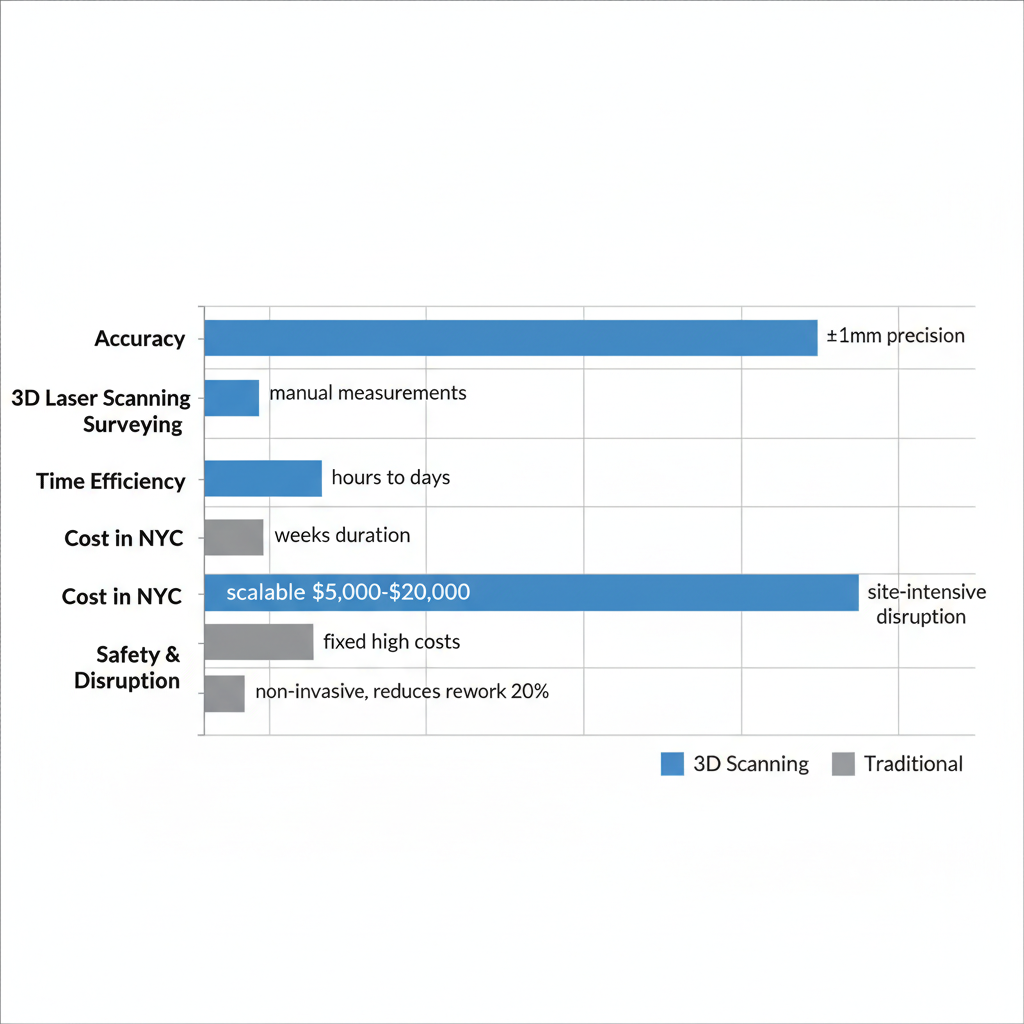
3D laser scanning vs. traditional surveying comparison for NYC projects
BuildScan3D tailors these applications to NYC needs, offering consulting for clash detection and virtual tours to drive project success and client engagement.
Available 3D Laser Scanning Services in New York City
For commercial projects requiring precise digital representations, BuildScan3D offers comprehensive 3D building scanning in New York City. As a leading provider, the firm specializes in transforming physical structures into actionable data through advanced laser scanning technologies. This ensures architects, contractors, and facility managers receive high-accuracy deliverables tailored to urban construction demands.
BuildScan3D’s 3D laser scanning services in New York City emphasize a hybrid approach, combining mobile LiDAR for quick captures on tight schedules and static terrestrial scanning for detailed precision. This flexibility suits NYC’s diverse project timelines, from rapid site assessments to in-depth building surveys. Services include post-processing for seamless data alignment, ensuring millimeter-level accuracy.
Key deliverables encompass:
- Point clouds: Raw data files for 3D modeling foundations.
- Revit models and scan to BIM in New York City: Conversion into intelligent building information models for design integration.
- Virtual tours: Online walkthroughs enabling remote progress monitoring without on-site visits.
- BOMA calculations: Compliant area measurements for real estate and facility planning.
- 2D floorplans: Accurate layouts supporting renovations and space management.
- MEP coordination and clash detection: Identifying conflicts in mechanical, electrical, and plumbing systems to reduce rework.
To illustrate quality, a recent Instagram post showcases a sample scan from a Manhattan high-rise, highlighting clean point cloud visualizations that aid in urban project coordination. These NYC scanning solutions streamline workflows for BIM services for urban projects, minimizing errors in complex environments.
From headquarters in White Plains, BuildScan3D provides reliable coverage across all five boroughs–Manhattan, Brooklyn, Queens, the Bronx, and Staten Island–plus surrounding areas. This extensive reach accounts for NYC regulations on site access and safety, delivering efficient scans for urgent projects citywide.
Ready to start your project? Contact BuildScan3D at their White Plains office for a customized quote and discuss how their expertise can support your needs in New York City.
Key Considerations for 3D Scanning Projects in NYC
Undertaking 3D building scanning in New York City requires careful planning to navigate urban complexities and ensure project success. Commercial clients evaluating providers like BuildScan3D must weigh several key factors, from budgeting to compliance, to achieve accurate digital representations of their sites.
Cost Analysis
Cost factors for NYC scans typically range from $5,000 to $50,000, depending on site size, complexity, and deliverable type. For instance, basic point cloud data suits smaller projects, while full scan to BIM in New York City demands higher investment for detailed Revit models. BIM conversion adds 20-30% to base scan costs per industry averages from the Scan to BIM Cost Guide, factoring in data processing and accuracy needs. Hybrid scanning approaches can enhance cost-efficiency, blending mobile LiDAR for speed with static scanners for precision, ideal for budget-conscious urban project planning.
Timeline and Compliance
Timelines for 3D laser scanning services in New York City generally span 1-3 days for on-site data capture in accessible areas, extending to 1-4 weeks for complete BIM delivery, including post-processing and model refinement. Local permits are essential for scanning in public spaces, such as sidewalks or landmarks, to comply with city regulations. Accuracy standards of ±1mm ensure reliable outputs for design and construction, while robust data security protocols protect sensitive information. Facility managers should prioritize BOMA compliance for standardized area calculations in modern or historic buildings, where preservation rules may add review steps.
Site Challenges
NYC’s dense urban layouts and elevated structures, like high-rises in Manhattan, pose unique hurdles for scanning teams. Tight access and potential obstructions require advanced equipment coordination, while historic districts demand non-invasive methods to avoid structural risks. Weather variability can also influence scheduling for outdoor elements.
Provider Tips
Select experienced firms offering customized quotes based on project scope. Request demonstrations of hybrid workflows to match your needs, ensuring seamless integration into workflows for reduced rework and faster approvals.
How to Start Your 3D Building Scanning Project in NYC
Launching a 3D building scanning project in New York City requires a structured approach to ensure efficiency and accuracy. With BuildScan3D’s expertise in 3D laser scanning services in New York City, you can initiate the scanning workflow seamlessly, transforming physical spaces into digital assets through scan to BIM in New York City.
Follow these six steps to kick off your BIM project kickoff:
- Contact BuildScan3D for a Quote: Reach out via phone at our White Plains headquarters or the website form. Provide site details like location in Midtown or Brooklyn, building size, and project goals to receive a tailored estimate within 24 hours.
- Schedule Field Assessment: Our team visits the site to evaluate needs, selecting mobile LiDAR for fast-paced urban projects or static scanners for high-precision work. Prepare by listing site access requirements, such as keyholder contacts and restricted areas.
- On-Site Data Collection: Technicians capture point clouds with minimal disruption, using hybrid methods to cover interiors and exteriors efficiently in bustling NYC environments.
- Post-Processing: Data undergoes registration and cleaning to create accurate, unified point clouds ready for modeling.
- BIM Modeling in Revit: Convert scans to intelligent models, including clash detection for MEP systems. As noted in industry insights, this scan-to-BIM process enhances collaboration across teams, streamlining workflows for NYC architects and contractors.
- Final Deliverables: Receive virtual tours, 2D plans, Revit files, and BOMA reports, plus consulting for integration into your project.
Contact today to start your project and leverage precise digital twins for success in New York City’s dynamic construction landscape.
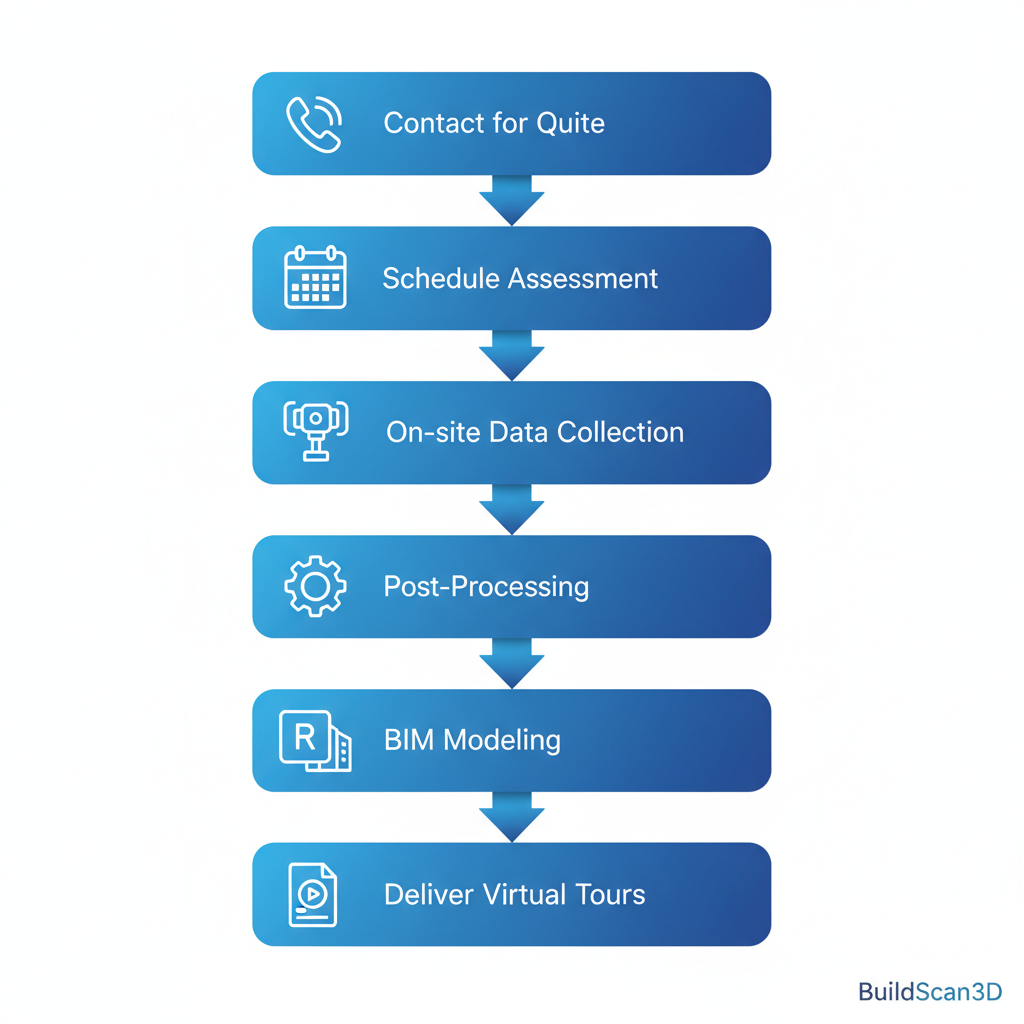
Six-step process to start your 3D building scanning project in NYC
Next Steps for Precision Scanning Solutions in New York City
Embracing 3D building scanning in New York City transforms construction and facilities management with precision NYC solutions for urban digital capture. Key applications include efficient workflows for commercial projects, from hybrid scanning to BIM deliverables that streamline coordination and reduce errors.
These services deliver ±1mm accuracy and comprehensive local coverage, reinforcing trust in high-stakes NYC environments. Start transforming your projects today with BuildScan3D’s tailored 3D laser scanning services in New York City and scan to BIM in New York City.
Contact us at buildscan3d.com or call (914) 946-7000 for a free quote. As outlined in industry analyses on scan to BIM’s digital transformation role, create streamlined digital twins that minimize rework and propel project success.
